Tuesday, 5 July 2022

 Des Moines in July 2021

The Des Moines Opera, our reason for going to Iowa, is located south of Des Moines in Indianola. Looking at the map, we discovered that Winterset, Iowa is west of Indianola. We had just seen the play Leaving Iowa at Theatre Lawrence; it is set in Winterset, and Winterset is the county seat of Madison County, known for its Bridges, so we wandered over there. We skipped the John Wayne museum, but did visit three of the six famous bridges. Here's the Holliwell Covered Bridge, built in 1880 to replace an earlier bridge. It is the longest covered bridge, and the longest timber bridge in Iowa. 

H. P. Jones and G. K. Foster, Holliwell Covered Bridge, 1880
All the bridges are accompanied by very helpful historic bronze labels. 

Downtown we noticed the Iowa Quilt Museum and stopped there, where the exhibition was 40x40@40: Celebrating 40 Years of the Manhattan Quilters Guild, You know you've been in Kansas a long time when you ask if the quilts are from Kansas and are told, "No, they're from New York." Each 40 by 40 inches, they were stunning works of art. Here are three:

Daphne Taylor, Quilt Drawing #21, 2017

Diana Goulston Robinson, Eye Catcher, 2019

Beth Carney, Movement 3, 2019
We continued to the Des Moines Art Center, known for its three iconic architects: Eliel Saarinen (1948 building), I.M.Pei (1968 expansion), and Richard Meier (1985 expansion), and for its sometimes daring and creative contemporary collecting. The exhibition there was Central America, work by Justin Favela, who refers both to his Central American heritage and to Iowa's Central American location. In the paper material used for pinatas he created an huge installation depicting works in the Art Center collection and images from Central America. The central object is a gigantic paper pizza. In the background of the photograph below you can see Favela's copy with a mirror image, of the Grant Wood painting in the Center's collection. The installation, obviously labor-intensive, was also exceptionally joyful, showing harvests, landscapes, palm trees, and scenes from life in the two Central Americas.


Grant Wood, The Birthplace of Herbert Hoover, 1931
The Des Moines collection challenges me to think about a wide range of mostly recent art, some familiar, some not. A few objects that caught my eye, beyond my favorite Anselm Kiefer, Fred Wilson, and Graciela Iturbide were this gorgeous Henry Ossawa Tanner of Christ Learning to Read, ca. 1911,

Nick Cave, Rescue, 2013, celebrating a ceramic dog surrounded by glass, metal and porcelain birds, flowers and beads.

In an overwhelming installation by Jamaican artist Ebony G. Patterson, AMONG THE BLADES BETWEEN THE FLOWERS...WHILE THE HORSE WATCHES...FOR THOSE WHO BEAR/BARE WITNESS, 2018, exuberant materials commemorate Jamaicans lost to slavery and racism.


As always, the opera production of Queen of Spades was well done. Joyce Castle was a triumph, looking appropriately frail and and singing absolutely beautifully. 


Sunday, 3 July 2022

 In the summer of 2021 we did some significant travel, beginning with the late April trip to Fargo, but continuing with a long weekend in Washington, DC that included the Walters Art Museum in Baltimore, Harpers Ferry, West Virginia, a performance of Pauline Viardot's chamber opera, Cendrillon at Wolf Trap and a quick visit to the National Gallery; then to Des Moines for the opera Queen of Spades with Joyce Castle in the title role, the Iowa Quilt Museum, a few Bridges of Madison County, and the Des Moines Art Center; New York, where there was no theater, but I was determined to see the Medici portrait exhibition at the Metropolitan Museum; Santa Fe for Indian Market, a trip that included a wonderful exhibition at the Albuquerque Museum of Art of the Transcendental Painting Group; and Skaneateles, New York for a reunion with my good friends from high school that included the Corning Glass Museum, which we have long wanted to visit. All these trips were between June and September. After a brief stay at home for apple season and Tom's birthday, we left again at the end of October for Padua and Venice, for our first visit to the Venice Architecture Biennale. Finally, on December 14 we spent a week in London, undaunted by the rapid rise of Omicron in England and the closure of theaters one after the other. Our vaccinations and boosters served us well and we completed all our journeys unaffected. Now, in summer 2022, with more trips behind me and having thought hard and photographed a lot, I'm determined to share, briefly, some of my reflections on these visits. 

The Walters is an amazing museum with a combination of contemporary exhibitions, rich collections, and an obvious commitment to finding multiple ways to address diversity in a collection that was formed by Eurocentric supporters of the Confederacy. The museum's history on its website is revelatory and eye-opening.

This was the first time I remember seeing the image below, the Anti-Slavery Cameo made by William Hackwood for Josiah Wedgwood. It is modelled on the medallion of the Society for Effecting the Abolition of the Slave Trade; it became a very popular object on both sides of the Atlantic and was the most recognized image of the anti-slavery movement. The label indicates that the modern viewer might find it problematic in that the man is kneeling, praying, pleading, maintaining racial hierarchy even as the text reads "Am I not a man and a brother?"  I've seen it several times since then and find it powerful and affecting nonetheless.


The cameo is displayed among a group of jewels given by the Walters family. It was purchased by the museum in 1989. 

On our visit the museum showed an exhibition of videos, installations and sculpture by six young artists of color from Baltimore, and another exhibition of important paintings and sculpture by African-American artists relatively recently added to the museum's collection. Here's River Scene, 1868 by Robert Seldon Duncanson (1821-71).


The museum also had a small show of ancient American works and prints to celebrate Mexican and Central American Independence (1821-2021). 

The Walters is unusual in that it displays significant parts of its collection in imitation of the cabinets of curiosities that were popular in Europe in the 16th century and later. Displaying natural objects and works of art together, this panoply of objects is fascinating and fun, and perhaps disturbing. Below is a painting depicting one of those rooms in the 16th century, followed by images of the cabinets at the Walters, including bones, shells, insects, coral objects, silver and gold vessels, gems, paintings, a globe, and ancient American sculpture and gold objects. 


The Walters is known for its collection of Southeast Asian art and even with a very short time to visit, it is very impressive. Here's just one example, a Thai seated Buddha:

One last image from our Washington trip is from the National Gallery. I'm a fan of the Fourth Plinth on Trafalgar Square in London, where a single work of contemporary sculpture is displayed for a period of time. Not long ago the sculpture was the huge blue Hahn/Cock, 2013 by Katarina Fritsch, an artist I first noticed at a Venice Biennale where she displayed a circle of huge black rats (Rat King, 1993). Hahn is now owned by the National Gallery and on display on the museum's roof garden. There's another version at the Minneapolis Institute of Arts. Me standing next to it gives a sense of the size.


Friday, 7 May 2021

Plains Art Museum, May 2021

We continued from Sioux City to Sioux Falls, then on to Fargo, North Dakota and the Plains Art Museum the next day. Both museums had free entry, all the staff and visitors were masked, and we were nearly the only ones there. In North Dakota, everyone asked if this was our 50th state. It was mine. I was amused that the next exhibition at the Plains Museum, Chakaia Booker, completes her mission to exhibit her work in all 50 states. 

The Plains Art Museum's building is completely different from the Sioux City Art Center, in that it is a repurposed turn-of-the-20th century warehouse for International Harvester farm machinery.  While the museum had existed since1965 in Moorhead, Minnesota, it opened in Fargo in 1997. The building is a beautiful adaptation, both contemporary and historic.

Plains Art Museum main lobby
Plains Art Museum upper lobby
The museum announces its intention to address a national audience with a monumental mural by James Rosenquist, the noted Pop artist who, I was surprised to learn, was from North Dakota. The mural celebrates North Dakota with multiple aspects of the state.
James Rosenquist, The North Dakota Mural, 2010
The permanent collection was not on view, but a highlights and recent acquisitions show opens this weekend. We saw the exhibition High Visibility: On Location in Rural America and Indian Country, which one might imagine would be similar to the state parks exhibition at Sioux City. But it was quite different. The works in the exhibition - by Euro-American, Native American, Latinx, and African American artists, most from the upper Midwest - each address individual experiences of life in rural communities and specific issues associated with those communities.

Each artist and each object in the exhibition addresses a specific community, and issue, and it is impossible to generalize about these issues. The first work we saw was Overburden/Overlook, a quilt work by Shanai Matteson, from Hibbing, Minnesota. The quilt suggests the map of a strip mine and consists of fabrics dyed with overburden, the soil removed to get access to mineral deposits in a strip mine.  Among the repeated words/phrases inscribed on the ravaged and patched fabric are "mine, not mine" "we drift dead dive into the deep" and "rise, sink." Matteson and Cannupa Hanska Luger are two artists in the exhibition involved in protesting oil pipelines in North Dakota and Minnesota.

Shanai Matteson, Overburden/Overlook, 2020, quilt

Another artist whose work involves oil is Chris Sauter, whose Family Oil Deposits; West Anderson Family, 2020, depicts the family tree of Muskogee/Creek artist Joe Harjo in the form of a network of oil deposits overlaying a map of Oklahoma river systems. 

Harjo's work in the show, Indian Holding a Weapon, 2019 consists of footprints documenting a performance of the same title.

Xavier Tavera's photographs depict aspects of Latinx migrants who worked on the land in the Red River Valley of northern Minnesota. Two are on view in the exhibition: Quinceanera, 2017, and Eva Mendez with Portrait of her Father, Crookston, 2017; his website has many more.

Jovan O. Speller's Lottie's Living Room, 2020, an installation, is intended to recall her enslaved ancestors in North Carolina, the issues of the last hundred years of Black land ownership, and her own childhood in California. For me it evoked a combination of poverty and family pride.

Jovan Speller, In Lottie's Living Room, 2020, installation
Athena Latocha, a Hunkpapa Laokta/Keweenaw Bay Ojibwe artist from Anchorage, Alaska, but living in New York, displayed an enormous looming dark mural across one entire wall. While I found it a depressing depiction of industrial degradation and destruction of nature, she seems to think it also evokes transformations in nature. I'm surprised that such a heavy, dark, large object can actually be a work on paper.
Athena Latocha, Buffalo Prairie (Slow Burn), 2019, sumi, walnut and powdered inks, shellac, steel belted tire shreds, local earth and grass on paper, Plains Art Museum purchase.

Some of the works in the exhibition revive traditional media: crop artist Lillian Colton's seed painting of Amelia Earhart, Su Legatt's screenprints with crocheted borders, Bruce Engebretson's woven tapestry All Water Holy Water, and Sabrina Hornung's cut-paper silhouette, Jackalope Valentine. All four connect to the cultural heritage of the Northern Plains and European immigrants there. 

Finally, as I was leaving, I realized that the large stained glass and metal sculpture actually depicted a discarded and crushed Busch Light beer can, an emblem of the rural road. I loved that artist Karl Unnasch remarked, "With every crushed can there is the hand of the maker," crushing your beer can makes a sculpture...

Karl Unnasch, Husk, 2020, stained glass, metal

I've mentioned only 11 of the 28 artists in the exhibition. Each of the others presented unique works that reflect aspects of their individual experience that also connect to larger issues. Sometimes I argued with the label content, but in every instance the art inspired interaction and engagement. In two museums in two days I encountered easy and reassuring beauty that left me calm and a bit aloof, and more challenging, less beautiful objects that caused me to think about issues of rural life. 


Thursday, 6 May 2021

Sioux City Art Center April 2021

Our first outing of 2021 was to Sioux City, Sioux Falls, and Fargo. The Sioux City Art Center, a lovely building designed by Joseph Gonzalez of Skidmore, Owings and Merrill and opened in 1994. The circular entrance court is reminiscent of the Richard Meier court of the High Museum, with stairs that circle the court and provide a refreshing break from art viewing. Lobbies outside the gallery are pleasant; one displayed midwestern ceramics. The permanent collection includes artists like Thomas Hart Benton and Kaethe Kollwitz that were not on view when we visited. We did see the very pale gold ethereal Grant Wood Corn Room murals, whose interest to me is primarily in their original hotel ballroom setting and history of being papered over, restored, and transferred to the museum, where they are housed in a meditative setting.

The main exhibition was 20 Artists 20 Parks. Twenty artists affiliated with Iowa State University each made work associated with one of the 20 state parks in Iowa. I thought this was an engaging and appealing concept and the work mostly had a kind of summer pleasantness, several of them versions of landscape. I was particularly taken by Deborah Pappenheimer's Architectural Navigators, 2019, a quilt of birds and flora associated with Walnut Woods State Park, and with Kristen Greteman's strips of blue cyanotype photography mounted on plexiglas, for Wildcat Den State Park 
Deborah Pappenheimer, Architectural Navigators, 2019, hand-dyed organza, embroidery thread, commercial fabric
Architectural Navigators, detail


Kristen Greteman, Wildcat State Park: A Deep Map, 2019, digital photography, cyanotype photography on Thai Kozo paper mounted on acrylic

The permanent collection focuses on regional artists, mostly from the upper Midwest. We appreciated seeing a painting by our Kansas City friend Marcus Cain, as well as work by Keith Jacobshagen, Larry Schwarm, and Gary Bowling. Catherine Ferguson made creative sculptures from everyday sources and  Stephen Dinsmore's Spring, the Pink Flowers seemed appropriate for the season.

Gary Bowline, Loess Hills Brushing in Winter Afternoon, 2000, oil on canvas

Marcus Cain, Ritual, 2018, acrylic on canvas

Catherine Ferguson, Laura, Sweet One, Van Rijn, 2013, bronze

Stephen Dinsmore, Spring, the Pink Flowers, 2007, oil on canvas

 Jennifer Homan's pastel landscapes are vibrant with huge skies, reminiscent of Jacobshagen; my photographs don't capture it. And I was somehow touched and befuddled by Christopher Meyer's Masked Consciousness, cast iron, an image that could only be from 2020.
Christopher Meyer, Masked Consciousness, 2020, cast iron
The permanent collection also displayed smaller works on paper by earlier artists, including early directors of the Art Center. It reminded me that each region has its home artists, whose work has special value to the community and that a museum serves the community by celebrating those artists. As an out-of-towner, I left feeling challenged in that I was unfamiliar with many of the artists, at the same time the works on view had been surprisingly accessible.

Sunday, 31 May 2020

More on Bertoldo


When I realized that my friends who read this blog probably have no idea who Bertoldo di Giovanni was or why he would deserve an exhibition, I thought I should add a bit of background information. Bertoldo was born in around 1440 and died in 1491. His reputation does not come from a single work of art or from all the works associated with him, but rather from his connection to two other Renaissance sculptors and a major Renaissance patron.

Bertoldo worked in Donatello’s studio and is credited with finishing some of Donatello’s work after Donatello died in 1466. One major project begun by Donatello, with which Bertoldo is connected is a pair of bronze pulpits in the church of San Lorenzo in Florence. No one has been able to definitively determine exactly what Bertoldo did there, but we know he worked with Donatello.

Then Bertoldo had strong connection with Lorenzo de Medici (1449-1492), who was the de facto ruler of Florence and a major patron of artists and collector of antiquities. Lorenzo had a sculpture garden containing many ancient works, near the church of San Marco in Florence. We know this from several documents, but we do not know exactly what was in the garden, since after the Medici were exiled in 1494, the works in the garden were dispersed. Lorenzo put Bertoldo in charge of that collection and several young artists habituated the garden, copying the antiquities, drawing, carving and modelling sculpture under the guidance of Bertoldo. The most famous of those young sculptors was Michelangelo.

So Bertoldo often gets credited with connecting Donatello, who died I 1466, with Michelangelo, who was born in 1475. From the exhibition catalogue, more than the exhibition, I’ve enjoyed thinking of Bertoldo as the artist who hung around with Lorenzo, discussing ancient art, sometimes advising on what to purchase, and making sculptures for Lorenzo’s rooms and buildings, always evoking the ancient culture that so fascinated Renaissance patrons. The catalogue essays also remind me that like other Renaissance artists, Bertoldo did not just make sculpture; he also designed ephemeral things associated with celebrations. For example, the documents refer to a 1478 fireworks wagon he designed for the festival of St. John the Baptist. The display failed and Bertoldo spent two weeks in prison.   

Friday, 29 May 2020

Bertoldo di Giovanni at the Frick Collection


In January I made a trip to New York, just to see the Bertoldo di Giovanni exhibition at the Frick Collection. I had no idea that New York would be closing down in a couple of months. My Ph.D. is in Italian Renaissance Sculpture, this was the first time the entire body of Bertoldo’s work has been shown in one place, and I was a graduate school colleague of Jim Draper, the Bertoldo expert to whom the catalogue is dedicated. It seemed important to go.

The Frick Collection has two small special exhibition galleries in the lower level, separated by a small vestibule where the exhibition catalogue is on display, usually with one work. I like this arrangement, mainly because it limits the number of objects on view and makes it easy to focus on the individual works of art without worrying about getting through an enormous display. I find it liberating that the exhibitions are relatively small and focused. Because exhibitions at the Frick are more scholarly than most, there are usually few visitors, again encouraging careful study of the works of art.

The Frick doesn’t permit photographs, but at an earlier visit the guard helpfully told me that the images are all available online, and that proves true for Bertoldo also. It is lovely that the Frick provides photographs and information on the works at its exhibition website, so you can see everything in the exhibition online. At the same time, it is particularly characteristic of sculpture exhibitions that reproductions cannot capture the spatial aspects of the works, the depth of relief, the details that can be seen from different viewing angles, and the way the art object actually occupies space. I love this about sculpture and I believe some painting experts find it challenging.

The exhibition included nineteen of the twenty works the curators think can be attributed to Bertoldo. One series of reliefs was noted only in the catalogue, since it is attached to a building, the Palazzo Scala della Gherardesca in Florence. And one series of reliefs, in the exhibition, was executed by at 
least five different artists, presumably after designs by Bertoldo. Bertoldo worked in Donatello’s studio had a role in training Michelangelo. Art historians see many connections among the three artists; part of the role of the exhibition was to call attention to Bertoldo as an artist in his own right, rather than just a conduit between two Renaissance geniuses. I much appreciated that. The exhibition catalogue is full of fascinating information and richly illustrated. Bertoldo was close to Lorenzo de’ Medici and even lived for a time in the Medici Palace.
Sarcofago 23, scene di battaglia tra Romani e Barbari (fine del II secolo), 01.JPG
Battle between Romans and barbarians, marble, late second century CE, Camposanto, Pisa. 
Bronze relief sculpture of a battle scene depicting nude or semi-nude soldiers attacking one another. Some soldiers are seated on horseback.
Bertoldo di Giovanni, Battle, bronze, ca. 1480-85, Museo Nazaionale del Bargello, Florence

The first work one saw, in that introductory vestibule, was Battle, ca. 1480-85, a bronze relief roughly 18 by 40 inches. Bertoldo copied it from a much larger marble Roman sarcophagus that he would have seen in the Benedictine abbey of San Zeno in Pisa. The sarcophagus was damaged, with most of the heads and the center portion gone, so he had the opportunity to revise it, at the same time he acknowledged his classical source. The label included a photograph of the sarcophagus and I was struck by how similar the compositions were; he definitely was copying the antiquity at the same time he was improvising on the theme of battle. Scholars have attempted to identify a specific battle, either mythological or contemporary, but they do not agree on the subject.  Seeing the work in person makes the high relief more striking; multiple heads and arms are in complete three dimensions. The faces, clothing, hair, and musculature of the men and horses are in crisp detail, the result of careful carving and polishing that were necessary to complete Renaissance bronzes after they are cast.
The interaction, intertwining of the active men and horses provides much to investigate. The relief is flanked by three female and one male standing figures, with two bound and captive nude males at their feet. The standing figures are copied, but modified, from the Roman original.

In the catalogue entry, Alexander J. Noelle points out that Bertoldo probably visited Pisa relatively often and acknowledges Wilhelm von Bode’s thought that Bertoldo would have accompanied Lorenzo de’ Medici on his frequent visits to Pisa, where Lorenzo had a home. Lorenzo was the de facto ruler of Florence, although he did not have any official position. Bertoldo had the unusual opportunity to be a friend of Lorenzo and at some times even to live in his palace. So, we might imagine Lorenzo and Bertoldo discussing the relief and Lorenzo asking Bertoldo to make him a version of the battle for his fireplace in the Palazzo Medici. The plan might have been simply to depict a battle, with no specific one in mind, providing his patron, Lorenzo de’ Medici, with a gorgeous classical subject for his palazzo.

How would he have made this copy? I imagine that he made detailed drawings and perhaps even modelled a copy of the relief in clay in Pisa and transported them to Florence, where he would have made the final wax model and had the bronze cast in a foundry there. Julia Day, in the exhibition catalogue, suggests that since Bertoldo lived in the Medici Palace, he may not have had space for his own foundry and used that of another artist and bronze caster, probably Adriano Fiorentino.
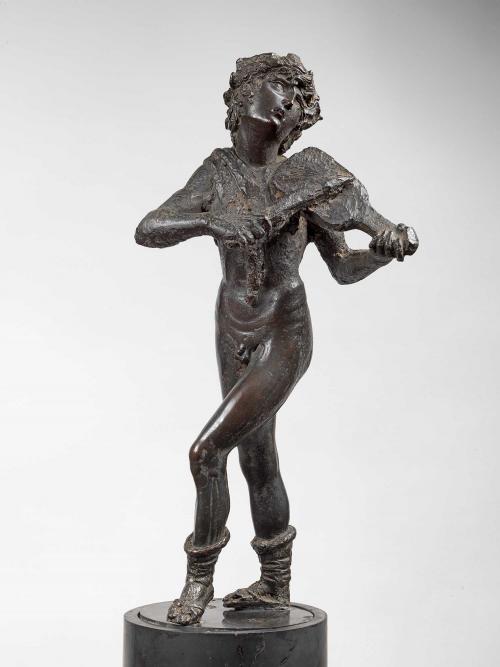
Bronze sculpture of a man playing an instrument that is propped on his shoulder.
Bertoldo di Giovanni, Orpheus , ca 1471, bronze, Museo Nazionale del Barbello, Florence
One of my favorite works in the exhibition is the small bronze titled Orpheus, but which has also been thought to represent Apollo. With his twisting body suggestive of dancing, his upturned head that seems in a bit of a trance, and his roughly formed lira da braccia (a common Renaissance stringed instrument), he evokes a spirit of music. The sculpture shows especially effectively how much work an artist does after a bronze is cast, chiseling, filing, and polishing the surface, since parts of it -half the face, the hair, the instrument, part of the torso and animal skin on his shoulders – are still rough-cast. The unfinished quality interestingly romanticizes the image. The catalogue reports a 1471 document published in 2005 that says Bertoldo gave a bronze of Orpheus to a woolen merchant to pay his bill. It is fascinating that the cast itself is seriously flawed, with a huge crack up the back, and to think Bertoldo gave up on it because of the flaw. In addition, he used it to pay a debt in 1471 and may have passed it to the woolen merchant without finishing it.
Bronze statuette depicting a man taming the winged horse Pegasus. The mythical animal is rearing on its hind legs, and the man is holding its jaw in one hand. In the other hand, the man holds a club, which he is about to use to strike the winged horse.
Bertoldo di Giovanni, Bellerophon Taming Pegasus, ca. 1480-82, bronze, Kunstkammer, Kunsthistorisches Museum, Vienna
Another documented work by Bertoldo is Belleraphon Taming Pegasus, which has the fascinating signature “Bertoldo modeled me, Adriano [Fiorentino] cast me,” documenting the association between Bertoldo the sculptor and Adriano the founder. Presumably Bertoldo did the final chasing after Adriano cast the figures in bronze. It captures the active nude Belleraphon taking control of the winged horse, Pegasus, with highly polished and carefully detailed surfaces.
Painted wood sculpture of a nude Saint Jerome striking his chest with a stone.
Donatello?, Bertoldo di Giovanni?, St. Jerome, ca 1465-66, wood, gesso, paint, Pinacoteca Comunale, Faenza
A wood sculpture of St. Jerome, covered in gesso and paint, seems to be the most controversial object in the exhibition, attributed to Donatello and/or Bertoldo. I gather that scholars continue to debate who made the figure, but my own response was to be repulsed by the odd color of the skin. I wondered how much it has been restored and what it might have looked like before it was repainted. The catalogue discusses what the conservators discovered during the restoration, and its photographs indicate that the surface was probably pretty completely remade so the work looks almost new.
stacked images of various scenes that are components of decorative facacde
Bertoldo di Giovanni and Followers, Frieze for the Portico of Vill Medici at Poggio a Caiano, ca 1490, glazed terracotta, Villa Medicea di Poggio a Caiano, Polo Museale della Toscana
The exhibition contains mostly bronzes, but I was surprised to see a terracotta frieze, from front of the Medici villa at Poggio a Caiano, arranged around the walls of the second gallery. While the unidentified subject is definitely classical, it’s obvious that several artists – the catalogue says five – executed it and there is no documentation that Bertoldo was associated with it. The attribution comes from the fact that he died at Poggio a Caiano and thus might have been there to design the frieze, which possibly he and others executed. The reliefs are varied in quality, with different depths of relief, different spacing of figures, and more and less clumsy modelling. But since it was intended for an upper cornice on the outside of a building, having the figures silhouetted against a blue background with some of the eyes exaggeratedly deep, might have been all that was necessary. It did make we want to go to Poggio a Caiano.

The exhibition also included six medals designed by Bertoldo. Nicely displayed, so both sides can be seen, they are historically interesting. Having some experience with medals, I find them very difficult to appreciate, however, without being able to hold them, since they were intended to be handled.
This was one of a series of exhibitions examining the work of Renaissance artists who worked in bronze. The Frick has a large collection of small bronzes and it’s impressive that they are using the collection as a springboard for fascinating exhibitions with substantial scholarly catalogues.

Wednesday, 22 January 2020

Verrocchio at the National Gallery

In November I went to Washington specifically to see the much-praised Andrea del Verrocchio exhibition at the National Gallery, and in January I went to New York primarily for the Bertoldo di Giovanni exhibition at the Frick Collection. As I await the Bertoldo catalogue, it's time to make some comments about the Verrocchio show. Both have closed.
My PhD focused on Italian Renaissance sculpture, but it has been years since I've followed the scholarship or engaged in discussions or debates about the subject. So while on the one hand I know more than a general audience, on the other I can't call myself an expert anymore. I had looked forward eagerly to the Verrocchio exhibition and was very disappointed. The catalogue has provided substantially more information about the works in the exhibition and it's very worthwhile, with several excellent essays. They explained some of my issues with the exhibition.

David, bronze with partial gilding, Museo Nazionale del Bargello,
Florence, bronzi 450 and 451
The exhibition was surprisingly small, just three galleries, one primarily sculpture, one drawings and one paintings. The centerpiece was the splendid bronze David, which looked great, but perhaps might have been easier to examine on a slightly lower pedestal. Because David's feet were at eye level, I became obsessed by his boots, which have sandal-like open toes and seem very thin, not exactly practical, but effective in showing the anatomy of his feet.
The label was informative about the process of completing such a large bronze, that casting was only a middle step and the entire work was patched, carved, hammered, polished, and gilded in order to become as smooth and detailed as it is. The catalogue discusses how Verrocchio may have used his experience casting bells and other large items in casting this relatively large free-standing metal sculpture. It also discusses Verrocchio's training as a goldsmith, an important aspect of Renaissance sculpture that is represented in the exhibition by a small agate covered vase and the terracotta study for a figure on the silver altar of Florence Baptistery.
Lady with Flowers, marble, Museo Nazionale del Bargello, Florence, 115.5


Other sculptures that caught my attention were the Putto with a Fish, a small figure that begins to twist in space, and the marble Lady with Flowers from the Bargello Museum in Florence.  The Lady with Flowers is subtly carved and polished, with a slight tilt of the head and hands that seem caught in gentle motion. She was far more beautiful than I had remembered.
Giuliano de' Medici, Andrea del Verrocchio, terracotta with traces of polychromy, National Gallery of Art, Andrew W. Mellon Collection, 1937.1.127

More sculptures include portraits of Giuliano and Lorenzo de' Medici, a marble relief possibly of Alexander the Great,, several terracotta studies, small bronzes, and a large candlestick, many of them attributed to Verrocchio and/or assistants.  The Alexander the Great is lovely white marble, perhaps a bit more precious than I like to think Verrocchio would have embraced. The portrait of Giuliano de' Medici is impressive.
Alexander the Great, Andrea del Verrocchio and Assistants? Carrara marble, National Gallery of Art, Gift of Thomas K. Straus, 1956.2.1
Like many exhibitions of Renaissance artists, this one could not include several key works, which are either too large or incorporated into the walls of buildings in Italy. The catalogue addresses several and this helps give Verrocchio his due as a sculptor. Sadly, one major work, Christ and St. Thomas, made for a niche on Or San Michele in Florence, was included in the Leonardo exhibition in Paris instead of this Verrocchio show. It alone would have given the exhibition more weight.
The paintings were more problematic. Gretchen A. Hirschauer and Elizabeth Walmsley in the catalogue identify two paintings as surely by Verrocchio, neither of which is in the exhibition and both of which are significantly collaborative productions. All the paintings in the exhibition are attributed to Verrocchio or  supposedly influenced by him or by artists in his studio. They are half-length Madonnas in a clearly late 15th-century somewhat linear style. While these Madonnas did share many similarities, it was difficult to see those given to Verrocchio as leaders or to see why the particular works were chosen for inclusion. But here's a link to some research on a couple of them. And it led me to fantasize the exhibition curators scrambling to find appropriate paintings to fill out the exhibition.
In the center of the gallery, completely outshining this parade of half-length Madonnas is Leonardo's portrait of Ginevra de' Benci, a subtly modeled image of a specific individual, with carefully calibrated and balanced colors. I always visit this painting when I am in the National Gallery and only recently have realized how condescending her expression is. Shown here among half-length Madonnas, it looks disturbingly truncated, cut off at the shoulders and missing both arms and hands. The cut-off emblem on the reverse of the painting confirms the loss, but this context really calls it to attention.
 Tobias and the Angel, Andrea del Verrocchio and assistants,
The National Gallery, London, Bought 1857, NG781


Attributing the fish and the dog in the probably-by-Verrocchio and studio Tobias and the Angel to Leonardo seemed odd, even though those particular details are remarkably well painted. From an artistic culture where collaboration was the norm, everyone seems to be trying to select out evidence of individual genius while the catalogue insists that all the production of a Florentine studio belongs to the studio head, i.e.Verrocchio.