Tuesday, 6 August 2019

Venice Biennale, Day 3 Afternoon National Pavilions at the Arsenale


The Biennale catalogue lists 26 national pavilions in the Arsenale. Those are in addition to the 29 official ones at the Giardini and the scores of them in apartments, shops, palaces, warehouses, and other venues hidden across the city. I’ve selected only a few that particularly caught my attention.

Because I made a couple of trips Amazon Peru in the ‘90s, starting in Iquitos, I was quite taken by Christian Bendayán’s rather complex installation in the Peruvian pavilion, “Indios Antropofágos”. A Butterfly Garden in the Jungle. Based on “exoticized images of jungle natives,” his Spanish tile compositions depicted transgender and transvestite characters enacting exaggerated versions of early 20th-century postcards of native people of Peru. Versions of the postcards, showing native Peruvians dancing or posing in groups are also included in this richly conceived installation.  The backgrounds of the tile compositions copied watercolors of Iquitos – on view in the exhibition - by the lepidopterist Otto Michael, who published books on Amazon butterflies after three multi-year expeditions to Peru between 1885 and 1921. Michael’s books are also on display, titled “Butterfly Hunter of the Amazon,” and Bendayán has included collages of Amazonian women with butterfly wings. This is a rich and dense installation, full of history, anthropology, socology and biology, very rewarding if one takes the time to look carefully. And the tiles, azulejos, are brightly colored and cheerful.
 

The Luxembourg Pavilion included a vast installation by Marco Godinho, Written by Water, of blank books that have been washed the water of various oceans. It is accompanied by a video documenting the books being washed by waves. The array of blank books, each a slightly different color of white and each with differently curled pages, was both peaceful and disturbing. Blank books, the ocean as a factor, and the whiteness of the pages call to mind bleaching coral and the power of the earth’s elements.

Kosovo’s Family Album is a video installation by Alban Muja that captured my attention for many minutes, as adults describe the meaning and memories they derive from photographs of themselves as children displaced by the Kosovo War of 1998-99. Their straightforward descriptions of the events they survived and their calm demeanor made the stories chilling.

The Ukraine Pavilion was somewhat ephemeral, but engaging, especially to Tom. As their entry to the Biennale, Ukraine sent the worlds largest cargo plane the Antonov AN-225 MRIYA on a flight over Venice on May 9, 2019, casting its shadow over the Giardini del Biennale.  In the cargo hold was a digital directory of all living Ukrainian artists.
brochure cover about the Antonov 224 cargo plane
The installation that touched me the most was another of multiple similar objects, this one from Saudi Arabia:  Zahrah Al Ghamdi’s After Illusion. It refers to a line from an ancient Arabic poem by Zuhayr bin Abi Sulma (520-609) referring to his attempt to recognize his home after having been away for 20 years. The installation is made up of thousands or round, sea-form like sculptures made from leather, attached to translucent lighted white shims and clustered on the floor. It was pleasant to walk through, evoking a world of peace and artistic creativity.


Layers of suspended black paper made up the installation by Joël Andrianomearisoa for the Madagascar Pavilion, that country’s first representation at Venice. It is beautifully simple, dark but not completely negative in feeling.


Latvian artist Daiga Grantina presented an installation of brightly colored forms suspended from the ceiling, leaning on the walls and resting on the floor, titled Saules Suns. They seemed playful, organic, cheerful, and a little menacing.


Ghana also had its first representation at Venice and chose to make a substantial pavilion, designed by Sir David Adjaye, the Ghanian-British architect. Among several artists included there were Lynette Yiadom-Bonkye, a very good painter, Felicia Abban, a photographer, and the famous ubiquitour El Anatsui, with several enormous wall pieces made as usual, from bottle caps and the like. They were so big I couldn't capture them in photographs.
Felicia Abban, Untitled Self-Portraits, ca. 1060s-70s

Lynette Yiadom-Boakye, The Mighty, Mighty Lines, 2019, oil on linen

El Anazui, Yaw Berko, 2019, aluminum printing plates, bottle tops, and copper wires.
Walking toward the end of the Arsenale, outdoors, we came upon a very old decrepit-looking boat, suspended near the water, obviously salvaged. We did not know at the time that this was the boat named Barca Nostra, which had sunk off the coast of Libya in 2015, drowning about 900 immigrants. The Swiss-Icelandic artist Christoph Bűchel had brought the boat to Venice. There are online images of it being transported to the lagoon.
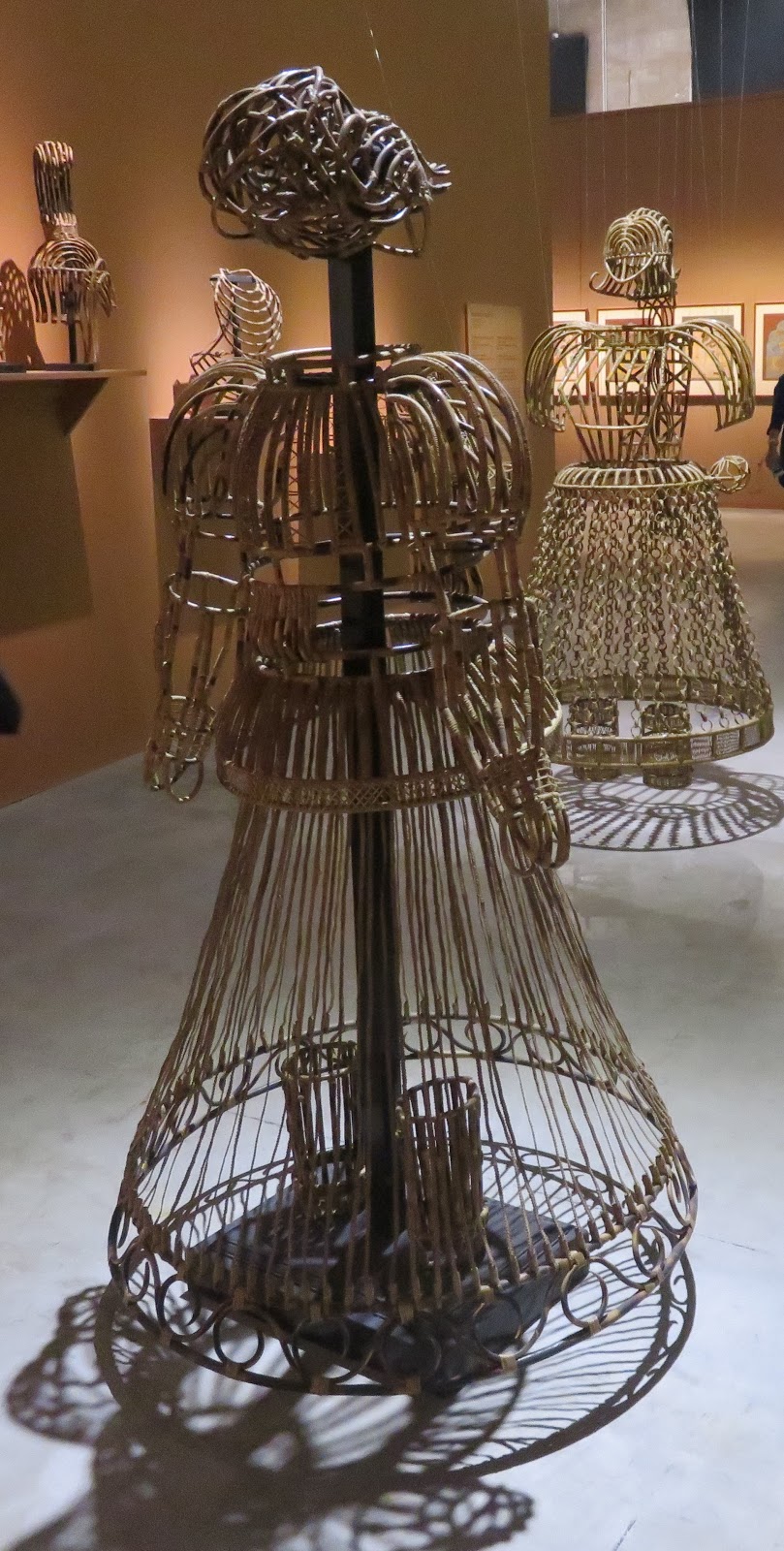
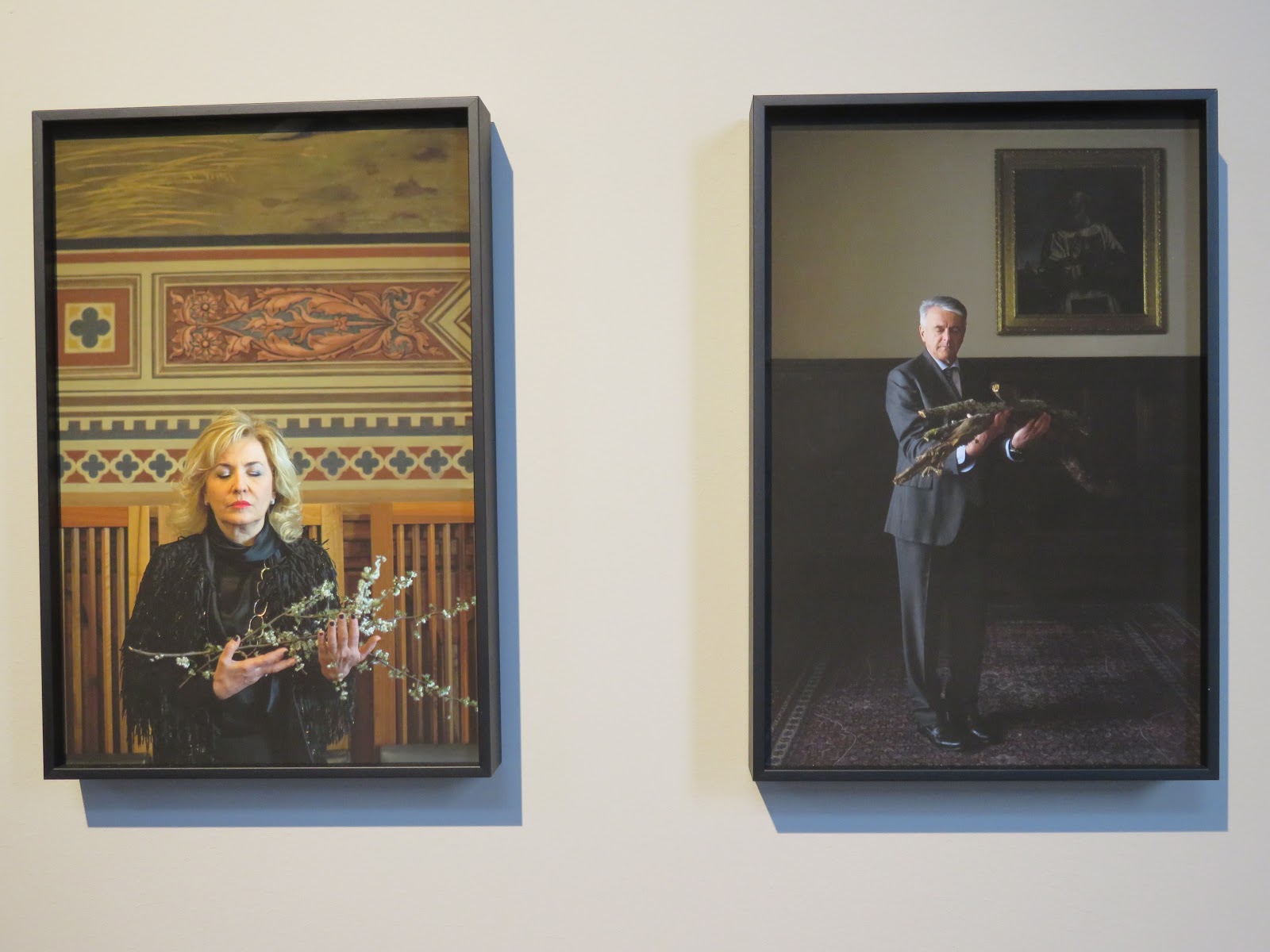
Among the several large pavilions at the end of the Arsenale building, we were most interested in India. The installation, Our Time for aFuture Caring, is based on the memory of Mahatma Gandhi. It opens with images of Gandhi and a quotation from him, “I am not a seer, rishi or philosopher of non-violence; I am only an artist on non-violence and desire to develop the art of non-violence in the realm of resistance,” Mohandas Karamchand Gandhi. The works of several younger artists and senior artists like Nandalal Bose, all refer to Gandhi’ s teachings and impact on India. I’ve chosen to focus on just two. The first installation, by GR Iranna, We Together, 2012, two walls full of single Indian sandals of the type worn by Gandhi, is another example of repeating the same element, in this instance peasant sandals, to larger effect than just a few sandals, a photograph or a painting would have. To me it spoke of all the kinds of people who wear this footwear, and all the walking Gandhi and his followers, and Indians, do.  Of Bodies, Armour, and Cages by Shakuntala Kulkarne, includes several cane dresses, headdresses and other forms, as well as photographs of women wearing the dresses. While being beautifully and artfully constructed, the works speak profoundly of women’s real and imagined constrictions.


GR Iranna, We Together, 2012


Shakuntala Kulkarni, Of Bodies, Armour, and Cages, 2010-2012
If you wonder where the Italy and China pavilions are, I did not photograph any of the works in these two very large venues. I did make a point of seeing the installation by Tomás Saraceno, an artist whose work has fascinated me since I first saw it at an earlier Biennale. On the Disappearance of Clouds, in one of my favorite parts of the Arsenale complex, relates conceptually to the effects of global warming, apparently moving with the motion of the tides, and accompanied by scores for music compositions on the same subject, these clouds were not as evocative as the webs we have seen by Saraceno in Venice and other venues. And I discovered, this installation was part of the curated exhibition. Some things were not very clear as we wandered through the spaces.

Saturday, 3 August 2019

Venice Biennale, Day 3, May You Live in Interesting Times

We spent our third day at the Arsenale, seeing half the curated group exhibition, May You Live in Interesting Times, and several national pavilions. When I was the director of the Spencer Museum of Art I was known for my interest in political art, art with a point of view and a concern for contemporary life, and perhaps injustice. We purchased such objects as Faith Ringgold’s Flag Story Quilt and Robert Arneson’s Nuclear Warhead (which after 1989 we actually thought had become obsolete!). But now we are starting to feel bombarded with a vast range of injustices present all over the world, which artists often present through either straightforward video documentaries or interviews. I understand and appreciate that politics plays a profound role in the arts these days, but when so many issues bombard us in an exhibition with multiple points of view from all over the world, I get tired and Tom is overwhelmed. This is why I liked Christine Macel’s 2017 biennale exhibition, Viva Arte Viva so much. She chose objects that expressed joy and creativity as much as political engagement, and I found it uplifting. I myself question the goal of feeling good in art exhibitions, but it seemed a welcome change from feeling helpless to solve all the problems of the world at once.

Like all the titles of Venice’s Biennale curated shows, this one was designed to permit anything to be included. I was drawn to many of the objects.

The striking black and white images by South African Zanele Muholi (b. 1972 Durban, South Africa) of herself in various elaborate garments and headdresses made from unlikely everyday materials had impressed me at the Museum of Contemporary Art in Cape Town last year. Here they were blown up to enormous size, like JR’s images, but not like his work at all.

Near the exhibition entrance was a series of photographs by Soham Gupta (b. 1988 Kolkata, India) of street people in India, heart wrenchingly charming and loving. The photographs show the humanity of people we usually avoid looking at and therefore seeing.


Unfortunately, these images were accompanied by the sounds of Christian Marclay’s (b. USA 1955, lives London) contribution, simultaneously projecting 48 war movies overlapped, with all their soundtracks playing at once, the sound of chaos and fighting booming from the room where the video is on view. Making separate spaces for different artists resulted in more bleed from one artist’s display to the other’s than I remember in previous Arsenale installations.
Christian Marclay, 48 War Movies, 2019, video


Very traditional, reminiscent of John Chamberlain but more evidently carefully constructed, I liked the large sculptures by Carol Bove (b. Geneva 1971, lives New York City), twisted interlocked forms with smooth surfaces and gentle colors (the catalogue calls them candy-colored). One must walk around them to see them and some have surprises on the other side.


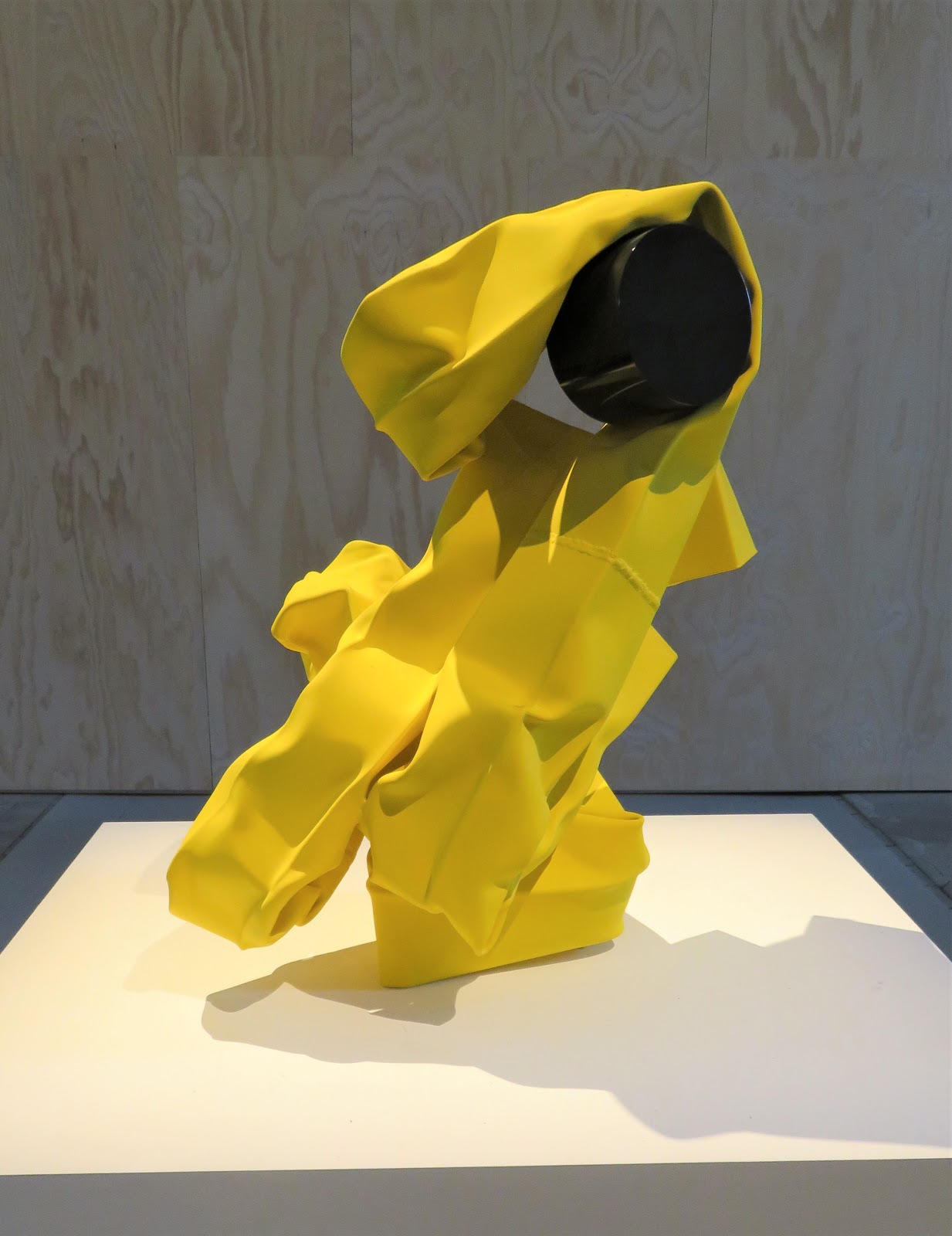
There were quite a few very large sculptures. Yin Xiuzhen (b. 1963, lives and works in Beijing) for example, created a huge pair of tires with metal connectors, suspended above the floor, next to Trojan, a gigantic image of a person bent over in an airplane seat in emergency landing mode. Her sculpture is hollow, presumably like the Trojan Horse.
Yen Xiuzhen, Trojan, 2016-17

Sun Yuan and Peng Yu had a chair with metal tubes that occasionally sprang to life, propelled by forced air, and Can’t Help Myself, 2016, the huge trapped painting machine that was on view a while ago at the Guggenheim. The first is pretty obvious, the second is actually touching, as the machine alternately clears and spatters paint and thrusts its ‘arm’ into the air as if in desperation. While a New York Times reviewer complained that most of the artists in this exhibition had already been seen in New York, he seemed to forget that there may be more people attending the biennale than New York art experts who have attended every gallery and museum there.
Speaking of artists who have been seen in New York, I was pleased to see work by Jimmie Durham (b. USA 1940, lives in Berlin), an artist I first saw decades ago, who virtually disappeared into Germany, and now is becoming visible everywhere, including a retrospective at the Whitney last year. He created European wild animals from skulls, metal tubing, an armoire, and clothes.   Like the mechanical paint brush, the works are amusing and touching at the same time, evoking their models with a sense of how they might be envisioned after they have gone extinct.


Ulrike Műller (b. 1971 Austria, lives in New York City) exhibited both rugs and paintings with her tight abstract designs. I loved that Rug (con tacones), a rug depicting what would walk on it, was hand woven in the workshop of Jeronimo and Josefina Hernandez Ruiz, Teotitlán del Valle, Oaxaca. This is a huge traditional rug-weaving center in Mexico. Her smaller abstract paintings seemed oddly traditional to me, but lovely. I could not see the critique of hierarchies, feminist or queer content attributed to her work in the label and catalog. Somehow the compositions of the smaller paintings are compelling. 


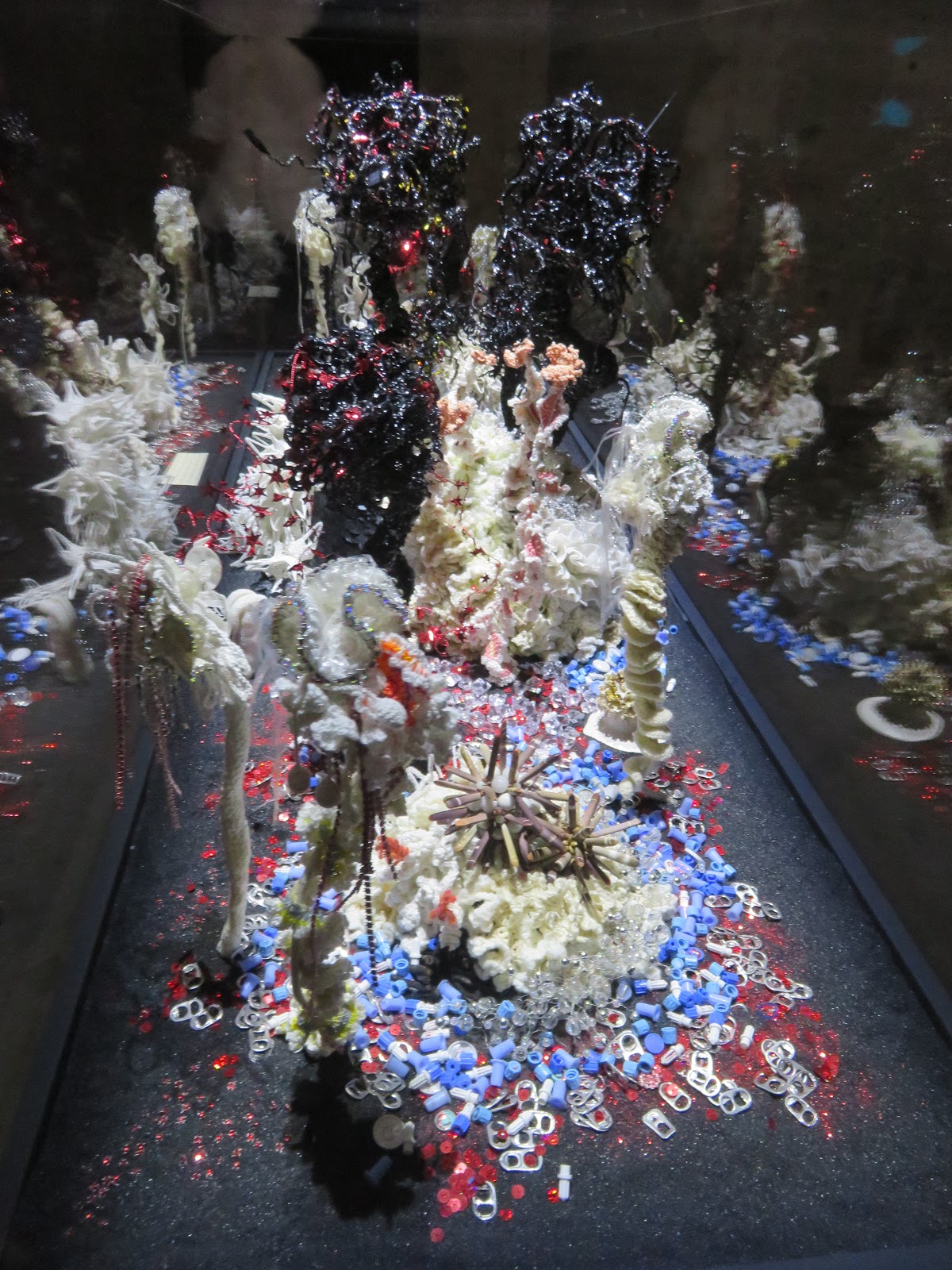
I was very much taken the Crochet Coral Reefs by Christine and Margaret Wertheim (b. 1958 Australia, live in Los Angeles), as well as a list of other makers added to the installation. Using totally unexpected materials, they call attention to an issue particularly urgent in Australia, but crucial to all of us. Bleached Reef and Toxic Reef I photographed.
Bleached Reef

Toxic Reef
Toxic Reef, detail

Toxic Reef, artists

Another work suggesting disappearing resources, but lovely as an object is Otobang Nkanga’s (b. 1974 Nigeria, lives in Antwerp) Veins Aligned, made of marble, glass and paint and snaking along the axis of a large room. It suggests a river and only as you reach the end, 26 meters away, do you see that it changes from lovely blue to a fierce red, suggesting contamination and pollution.


Anthony Hernandez’s (b. 1947 Los Angeles, lives in L. A. and Idaho) photographs of contemporary unfinished and failed projects in Rome may challenge the wastefulness of urban renewal but they are often beautifully composed images that abstract the structures.  


And Tavares Strachan’s (b. 1979 Nassau, lives in New York and Nassau) neon text, Robert, 2018, shocked and distressed me as many of the more vocal videos did not.


Market, by Zhanno Kadyrova (b. 1981 Brovery, Ukraine, lives in Kyiv) near the end of the curated show, amused us as a ceramic tile, cement, mirror and stone recreation of an outdoor market, and was a good installation to lead us into lunch.

Friday, 26 July 2019

Venice - Day Two - Far away places


On our second day we visited two exhibitions that are relatively distant from the center of Venice. First was the Golden-Lion-winning Lithuanian Pavilion, Sun and Sea (Marina) which is across the island from the Arsenal, probably not that far walking, but we chose to find the closest vaporetto stop, Celestia, only a couple of blocks from the site. We went on Wednesday, thinking there wouldn’t be too much of a crown, and indeed the line was not long, and we waited about 20 minutes. When we left, about noon, there was no line at all. The pavilion is in a military installation, with signs warning visitors to stay on the path. Inside, we heard ethereal singing and climbed out to a balcony surrounding the scene of people on a fictive beach, complete with balls, chairs toys, books, and everything one associates with a well populated seaside. As all the reviews say, the beach occupants sing arias and choruses about a variety of beach experiences, some pleasant, some terrible, and some both at once. I thought the work should be presented as a one-act opera, which is what it really is, and I would be happy to see it again in that context. It was dark. Although I could understand much of the singing, which was in English, I wanted to follow in the libretto, but it was not easy to see it and there weren’t enough chairs for everyone. So I read ahead and we left before it was over. Tom and I both liked it very much.


Our next stop was the installation by Edmund de Waal, Psalm, in the Jewish Museum in the Venice Ghetto. To get there we took the Number 2 vaporetto the rest of the way around the island, passing residential and industrial areas we had never seen before, plus the cruise ship docks and the bus terminal. Just outside the ghetto we stopped in a nondescript restaurant and had a wonderful lunch, surrounded by locals and Asian tourists.

The Ghetto was established in 1516, and the word ghetto comes from there. I had been in the ghetto before, but had not visited the museum, which is a fascinating  combination of memorials to former residents, objects associated with services, historical materials, and a the beautiful, richly appointed sixteenth-century Canton Scuola synagogue, which, not being Jewish or members,  we could only view from windows. De Waal installed his works in rooms and a corridor near the synagogue. They consist of various sizes of wall display cases, shelves or pedestals with white porcelain cylinders of various sizes and shapes, box forms that may also be porcelain, and gold leaf. No matter how one looks, it is impossible to see all the forms completely as they are set in front of each other with just glimpses visible. His work reminds me of the Zen garden at Ryoan-ji, where no matter where you sit you cannot see all the stones. I want to be profoundly moved by these installations, but it doesn’t happen. I loved The Hare with Amber Eyes and found it very moving. I wish his works of art had the same effect.

My photographs are inadequate; going to de Waal’s website provides better images.


De Waal also did an installation at the Ateneo Veneto, with shelves on which he put both his porcelains and almost 2000 books by exiled writers, mostly in translation, which visitors were encouraged to take down and read, as well as lists of lost and erased libraries in the world. We did not go to that part, which I regret because the concept is so powerful. At the same time, I’m very grateful that he led us to the ghetto and the museum there. In several locations in the ghetto there were posted copies of a Wall Street Journal article about the place and its synagogues, with information on tours.


We headed back toward our hotel, getting off the vaporetto at San Zaccaria and stopping at a few sites we’ve visited in the past: the church of Santa Maria della Pieta, with a collateral installation, Processional by California artist ToddWilliamson, and, in a nearby building, rooms holding the Andorra, Zimbabwe, and San Marino Pavilions. The Todd Williamson installation is in a side corridor, called a chapel in the information. It includes paintings, a recorded musical composition, Nocturne, by Greg Walter from the University of North Carolina, and five bronze panels with inspirational quotations by famous people in Latin, with casually placed translations on a chair in the corridor. The abstract paintings are rich and strong. I found the combination of music and paintings surprisingly moving, although I wondered about the inspirational quotations in that context. Maybe he’s trying to say that good things can be said by the strangest people. The church, of course, is known as Vivaldi’s home church.  Here are one of the paintings and two of the panels:
No dream is too big/ No challenge is too great
Nothing we want for our future is beyond our reach

You know you are on the road to success
 if you would do your job and not be paid for it.
Did they really say those things? Sounds a bit like Jenny Holzer.... 


There were five quotation panels in all. I liked Elan Musk’s especially: “It’s okay to have your eggs in one basket as long as you control what happens to that basket.” It sounded like him and it sounded like a reasonable idea. I’m hopeful that the Trump quotation will hold true for me in the 2020 election. And I thought Oprah was forgetting all the people who do what they love for nothing because they can’t get paid for it and those who don’t get paid adequately for what they do.

We enjoyed the Zimbabwe Pavilion. The attendant there was from Zimbabwe and when we suggested that Venice must be quite foreign to him, he said the biggest wild animal he had seen in Venice was a pigeon! The pavilion has the title Soko Risina Musoro, which I learned is the title of an epic poem written by Zimbabwean NationalistHerbert Chitepo, translated as The Tale Without a Head. I cannot find the date when the poem was written, but Chitepo was born in 1923 and assassinated in 1975. Four artists are shown there, two men and two women. I particularly liked Georgina Maxim’s fiber works, large, beautifully colored, and densely packed
Georgina Maxim, Mai Mugari I, textile mixed media, 2019
,
and I was taken by Kudzanai-Violet Hwami’s large abstracted representational images derived from her own family and from Southern African life. 
Kudzanai Violet Hwami, Jovian Swirl, acrylic and oil on canvas, 2019

 Neville Starling’s photograph- based works made very effective reference to his father’s Alzheimer’s memory loss and to the idea of memory loss altogether. 
Neville Starling, White Lies, multimedia

Cosmas Shiridzinomwa’s large paintings, titled Fruitless Discussions and Violent Discussions express their ideas through twisted tables and chairs with hands. 
Cosmas Shiridzinomwa, Fruitless Discussions I, oil on canvas, 2013

We were disappointed with the Andorra Pavilion, which had been one of our favorites in 2017. (Sorry, I have to skip some things.) And we were puzzled that the San Marino Pavilion displayed Chinese artists, which I now understaSnd is a result of something they call a Friendship Project International. One of them was Xu De Qi, whose Beauty and the Beast series I found particularly unappealing. 
Xu De Qi, Beauty and the Beast

Another, Cheng Chengwei, displayed beautifully crafted hyperrealist images that somehow felt disturbing and politically charged by just depicting a man and a woman. 

Chen Chenwei, Series on the Republic of China, Shadows in the Moonlight, oil on canvas, 2014
And a San Marino artist, Martina Conti, apparently enlisted members of Parliament to pose for her photographs.


 This gives some sense of the diversity of experiences one has trying to see what's on view among the hundreds of offerings during the Biennale, and it's only the second day, before we actually attended the central two venues.