Friday, 24 April 2015

Keys to a passion: Fondation Louis Vuitton


One of the reasons we went to Paris was to see the Fondation Louis Vuitton and its new Frank Gehry Building. We were fascinated by the building, as everyone else has been. I loved that Gehry has truly separated the “sails” that cover the building from its actual structure, that there are many levels under those sails to explore outdoors, and that the galleries indoors are rectangular with straight vertical walls. I also like the sculptural shape of the interior structure as you see it from outside, contradicting the regularity of the interior spaces. I could not photograph it from above or the long side, so what I can offer are details of the complexity of the structure.


The building structure makes some sense, it seems almost infinitely varied, and it is possible to install most kinds of art appropriately in the galleries. A couple of the galleries have wonderful high skylights, where sunlight can enter but is unlikely to hit works of art directly.

We explored the building and its permanent collection exhibits – a quirky variety of generations and media. A video by Akram Zaatari, Tomorrow Everything will be Alright, 2010 seemed familiar and we realized that we had seen it two years ago at the Museo de Arte Contemporaneo (MUAC) in Mexico City. Given the political nature of much of his work, choosing this one for a collection seems a bit eccentric, although its gay theme and easy accessibility, at least to an English reader, may be considerable assets. Giacometti and Ellsworth Kelly among artists I find more difficult: Isa Genzken, Annette Messager, and other contemporaries - Maurizio Cattelan, Thomas Schutte, Adrian Villar Rojas.
 
Wandering downstairs, partly intending to get a closer look at the water feature, we found the exhibition, Keys to a passion, which coincidentally had opened the day before. This exhibition has already been widely discussed just because of the rarity and high value of the loans, important treasures from major international museums. The atrium was set up for crowds, but there were very few people. Guides handed us a booklet of all the exhibition labels in English, a wonderful asset that enables one to read the label and look at the art at the same time, without having to wait for the nearsighted person or people in front to finish. And you can re-read them later.
 
It took us a while to realize how stunning the exhibition is. Organized on four disparate and inconsistent themes: subjective expressionism, contemplative, Popist (as in Pop, not the Pope), and music, the works, about 60 objects by 29 artists, are generously spaced in six rooms. The guide says they "established the foundations of modernity.... By breaking rules, these irreducibly singular works have become touchstones in the history of art." Well, I think maybe some of them more than others, although each object merits the substantial examination and contemplation the organizers hope for.
 
Indeed the works are masterpieces, but perhaps because we had no publicity to set us up for it, we didn't feel like we were in a textbook of masterpieces. Not everything was completely familiar and I was most taken by Nolde, Hodler and Mondrian landscapes, a Malevich figure, a gorgeous red Rothko, and the two Franz Kupkas. Of course, the Kandinskys from the Edward R. Campbell atrium, Matisse's Dance, and the Munch Scream were obviously major loans. And, finally I wondered, and still wonder, how the curators chose works by three other artists. First were five self-portraits by the wonderful Finnish artist Helene Schjerfbeck, whose major retrospective we saw in Helsinki three years ago. They are stunning and hold their own with the Munch and Otto Dix's Portrait of the Dancer Anita Berber, 1925 (Tom's favorite) nearby. But her expressionism without any of the standard Germans seems a bit odd.
 
Similarly, in the "contemplative" section, near the Noldes and Mondrians were four very similar paintings of Lake Keitele by the Finnish artist Akseli Gallen-Kallela. I was engaged by the slight variations in the stylized interpretations of this series, impressed that the four paintings had been brought together from at least three disparate collections, and curious as to what inspired these particular works to join the exhibition, especially since they are quite uncharacteristic of his oeuvre, which we had the chance to see in a major exhibition in Dusseldorf in 2012. Perhaps the Vuitton curator made the same rounds we did of Finnish artists in 2012. And I wondered if the artist was continuing to work out a composition, as the label suggests, or if he found a popular subject and was repeating it for additional sales. The paintings certainly fit into the context of the room, but seem unlikely as foundation works for later art, especially when one of them was acquired by the National Gallery in London only in 1999 and become "iconic" only since then.
 
Then, in the section titled "Popist," which I initially believed must have to do with the Catholic religion, I was rather puzzled at Robert Delauney's inclusion, since I think of him more for his abstraction and color than for his popular subjects. But the real amusement came from Francis Picabia's cavorting naked women with dogs that seemed to come from exactly the same girlie aesthetic as the Jeff Koons paintings I had rather dismissed the day before. These Picabias were as unlikely in their present company as the Finnish artists in theirs, and again I wondered what the curatorial impetus was for including them as sources of the "Pop" in modern art. They are also quite different from most of Picabia's work, as is evident if you search Picabia images.
 
So I am curious and puzzled by some of the curatorial choices in this exhibition, which nonetheless is one of the three really memorable, important, and innovative shows we saw in Paris.


Thursday, 23 April 2015

Jeff Koons at the Pompidou Center

In Paris earlier this month we made a point of visiting the Jeff Koons exhibition at the Pompidou Center. Koons is a puzzlement to me. I want to be able to dismiss him, as several critics do, as vacuous and pandering to collecting fashion, but somehow that seems to dismiss the fact that Koons is so popular with the general public, with collectors, and with some critics. His commercialism and superficiality speak to an aspect of contemporary American culture. But it’s a little embarrassing to think that we embrace that superficiality as eagerly and fully as the market for his work would indicate.

So I wanted to see how the work was presented and interpreted by the exhibition curators. They provided some excellent context that helped me to see what inspired the objects and to understand Koons’s process. But in the end I still don’t feel convinced that I should value his art emotionally or intellectually, because it doesn’t mean much to me, even if it does, sadly, speak to contemporary culture and is occasionally amusing.

I was surprised that the first few objects were simply store-bought inflatable flowers and a bunny set against mirrors. By using mirrors Koons refers to Robert Smithson’s mirror works, although Smithson uses the mirror corner to enlarge or modify the object - usually a small earthwork - set against it. Then Koons set teapots and vacuum cleaners against florescent bulbs, the “found” objects inspired by Marcel Duchamp and Dada and the lights perhaps by Dan Flavin’s florescent works. While the labels indicate that the vacuum cleaners will remain pristine in their plexi boxes, they will eventually deteriorate. Personally I do not find the forms of the teapots and vacuum cleaners to have the design sense or the wry humor of Duchamp’s readymades. Duchamp makes you look at everyday objects aesthetically and see them as sculpture or design: not so much with Koons’s vacuum cleaners.

The first Koons I ever saw was the floating basketball, which left me cold many years ago. We did not see this in Paris, but it is in the catalog, something about equilibrium, in a series about rising and falling basketball stars and bronze aqualungs and lifeboats, perhaps deriving from trompe l’oeil sculptures of the 1970s.

I was very interested in the section where Koons enlarged alcohol ads to monumental size because he says he was interested in how the ads became more abstract as the neighborhood became wealthier. However, although I imagined that it was there, I couldn’t actually see anything about that in the ads exhibited – they were just enlarged booze ads, as Richard Prince had done with tobacco ads.

I thought the 1986 stainless steel model train that actually contained bourbon was interesting (had no idea the artist's proof had sold for $33,765,000 in 2014), but couldn’t really figure much out from it, except that it seemed to reproduce a commercial set of Jim Bean bottles.  I suppose alcohol ads and bottles are always fun. This was followed by multiple stainless steel casts of baroque portrait busts and other sculptures. The labels address the fact that stainless steel is a “proletarian” material and so the busts suggest “fake luxury.” They are shiny and cold and pretty boring replicas. Among them was a stainless steel reproduction of an inflatable rabbit, which the label says ‘transforms this inflatable disposable object into a durable and precious one,’ (albeit of “proletarian” material). Even when the curator offers several interpretations, it still looks to me like a cute trick.

Buster Keaton, 1988
Polychromed wood (Ed. 3/3)
Sonnabend Collection
and Antonio Homem
 
We used to have a small collection of ANRI figurines, which I sold on Ebay several years ago for more money than I’d expected. Koons’s Banality series of giant versions of cutsey carvings reminds me of those figures. Is making collectibles giant a way of giving them aesthetic value? Or is it pandering to the lowest common denominator? Koons’s comments seem to co-opt the condescension I feel toward these really, really stupid objects. Following these with the vapid pretty-faced images of Koons himself having sex and/or sculpted heroically in marble starts to make my stomach ache. On the other hand, I did sort of want the blue glass version of him having sex for our glass collection.

Michael Jackson and Bubbles, 1988
Porcelain (Ed. 1/3)
Private Collecton
Then there’s Michael Jackson and Bubbles, a huge gilt porcelain sculpture copied from a photograph, made by assistants in a sophisticated technique in an edition of three. Having little personal interest in Michael Jackson, I still find this entertaining in its lush surfaces and Pop sources., not to mention that it has become some kind of icon of both Jackson and Koons.

Balloon Dog (Magenta), 1994-2000
Stainless steel, clear polyester, transparent varnish
1 of 5 unique versions
Pinault Collection
I also loved the giant topiary Puppy when we saw it in front of the Guggenheim Bilbao in 1999. And I can’t help but smile at the giant Balloon Dog that exists in five versions. It’s shiny, looks like a child’s toy, and contrasts the hardness of steel with the fragility of balloons. I think it’s fun and a kind of extension of Pop art, but I can’t take it very seriously. What does that mean? I smile when I see these works and that’s fine, but they don’t cause me to think or feel anything more profound than that initial response. Amusement and delight are valid responses to a work of art, though and more than a lot of art evokes from me.

About this time in the exhibition I learned that all of Koons’s paintings are executed by assistants following a paint-by-numbers system to assure conformity to his requirements. And I find minimal evidence that he draws or paints or sculpts himself. Andy Warhol’s studio concept is fully realized in Koons’s production system, where the ideas are his (I must assume) but the execution is by others, as in a factory.  The effect of this painting system is surprisingly photo-realistic. My snapshot of a detail of a painting looks to me like the actual plastic toy sculpture. And the sculptures are meticulously crafted by the fabricators he employs.

Shelter, 1996-98, detail
Oil on canvas
The Rachel and Jean-Pierre Lehmann Collection

There follow quite a few paintings in various series that combine multiple commercial sources (“product packaging, advertisements, and magazine photography,” as well as cartoons and images of toys) in collages that are then significantly enlarged and painted by assistants. They remind me of Frank Stella’s paintings that employed computer imaging; here Stella’s smoke patterns are replaced by fishnet stockings.

More recent editions in the exhibition were Antiquity, monumental reproductions of well-known sculptures in brightly colored stainless steel, so shiny that they are difficult to see and in colors that make me grit my teeth. In fact one effect of all the detailed stainless-steel sculptures is that they are very difficult to see because of the hard reflectiveness of the medium. These were followed by Gazing Ball, mostly oversize plaster replicas of famous classical sculptures,  each holding a blue gazing ball, combining two garden-sculpture types.  (The addition of a mailbox with a gazing ball might be intended to clue me that the works are about things one would fine outdoors.) It’s a way of transforming ancient treasures into contemporary kitsch, so the collector can have it both ways, I suppose, i.e. the ancient object and a spoof of antiquity, but not a garden sculpture, since the plaster would not survive well out-of-doors.
Gazing Ball (Farnese Hercules), 2013
Plaster and glass (Ed. 3/3)
Private Collection


Wednesday, 15 April 2015

Sarah Burt

My friend Sarah Burt died on Tuesday April 7 after about 5 months struggling with pancreatic cancer. I’m glad I saw her in early March, when she was still feeling relatively good and we could have the endless conversations we, and all her friends, have always enjoyed with her. Sarah had a long career, first as a journalist, then as an art historian, but at the age of 62 she was just coming into her own as a scholar and curator and when I saw her in August, before she was diagnosed, I was really impressed with her accomplishments and her confidence about her work as a museum curator. She was always a brilliant scholar. You would tell Sarah about something that interested you that she had never heard of and the next time you saw her she could tell you everything about it. And she had ideas!  About artists, about exhibitions, about the way art works.

Sarah started graduate school at the University of Kansas in the Japanese art program, but about the time she completed the masters she realized that the Japanese language was going to be too much of a challenge and she switched to American art. As I recall, she worked on William Keith, and on the Swedenborgians, helped with American painting publications at the Nelson-Atkins Museum, then got a job in Santa Fe working for the Georgia O’Keefe Foundation, where she was assistant curator for an exhibition of O’Keefe’s book collection. After she was hired at the Joslyn in Omaha as the curator of Western Art she became extremely knowledgeable about Karl Bodmer and Maximilian’s expedition up the Missouri, and began to make scholarly and museum connections in that field. Finally, as curator of the Charles M. Russell Museum in Great Plains, she immersed herself in Russell and his compatriots, as well as managing many details for the museum’s annual auction of contemporary and historical Western Art. At the Russell Museum she was still in the upward curve of her scholarly arc and had many more great projects in the works.
Sarah was a collector. She had collected American arts and crafts pottery in Kansas, then lost it in a divorce, but still had some of her European pottery. She had well-chosen Western landscapes; I was always impressed that she could pick out the best object in a group. And she loved to talk about objects and their history with dealers and curators, usually in great detail. Once when we went to the flea market in Santa Fe she deliberated and negotiated over a rug for hours, finally purchasing it.
Sarah loved movies and we loved to go to them when she was in Lawrence. She knew a great many movies of the 30s and 40s, as well as good contemporary ones. When I saw her in Great Falls, we watched “The Grand Budapest Hotel” and a couple of episodes of “House of Cards.” She loved good food and wine. While I would order the house white, she would choose the Puligny Montrachet or the Russian River chardonnay or something else much more exotic.
Probably most of all, she loved her dogs.  She had always wanted Border Collies and got the first ones about 17 years ago. First Sam and Maggie, brother and sister she acquired in Santa Fe and kept with her till they died at over 15 years old. They went everywhere with her and she had them trained to do all sort of amazing things, so that you almost thought they could talk (Of course they could speak, and whisper.). More recently she acquired Alice, the very smart, quick one, and Sylvester, who is beautiful and loving but perhaps a little intellectually challenged.
For the first two years I was in Kansas, Sarah and her husband were my only Lawrence friends, and we regularly went to movies, to Kansas City, and on trips together.– skiing in Wyoming and Montana,  hiking in Rocky Mountain National Park.  After she moved to Santa Fe I often stayed with her there and she was a guest at my wedding in 2005. We have a huge email correspondence, detailing our activities for the past decade.
I visited Sarah in Great Falls in August, a couple of months before she was diagnosed, when she was feeling pretty good. We toured the Russell Museum, which is much larger than I had anticipated and much of which she had reinstalled very intelligently. Then we went to Glacier National Park, staying at the lodges Sarah most liked, eating the best meals we could get, and driving through the park, looking for mountain goats for Sarah and bears for me. We found the goats first and I took her picture with the goat in the distance. Then when we were almost through the park we came upon a crowd watching a mother and baby bear, so we both got our wishes fulfilled.

Monday, 2 March 2015

Orozco - The Hospicio Cabanas

Continuing with images of Orozco in Guadalajara with descriptions of the frescoes from Desmond Rochfort's Mexican Muralists. The Hospicio Cabanas was founded in 1791 by Bishop Ruiz de Cabanas, who planned it as a combination workhouse, hospital, orphanage, and almshouse. The architect who designed it was Manuel Tolsa from Mexico City, but he died before it was completed. It served as a hospital until 1980, when it was converted to the Cabanas Cultural Institute.

Orozco painted 57 frescoes in the building, covering the vaulted ceiling and walls with scenes of the history of Mexico from before the Spanish arrived to early 20th century industrialization. Like the other Guadalajara frescoes, his history has few heroes and does not suggest either an idyllic pre-Hispanic world or progress toward a peaceful and cultured present.

The transepts have images of ancient Mexico as a barbaric world, with rituals for the god of war, Huitzilipochtli.
Huitzilipochtli, God of War

Rituals


In the vaults of the nave, he depicted the Spanish conquest, with Philip II of Spain carrying a cross and crown, two-headed horses, and a Franciscan monk who carries a cross that doubles as a dagger. The Franciscan stands in front of a sheet of letters, indicating that the missionaries brought reading as well as torment to the Mexican people.
Philip II of Spain

Cabanas ceiling, Franciscan

Two-headed horse, Spanish conquest

An armored horse, a mechanical, machine horse and rider suggests the invincible force of the Spanish army, and anticipates Jared Diamond's Guns, Germs and Steel, as the Aztecs, weakened by foreign diseases, were no match for the Spanish weapons and armor.

Mechanized horse and rider

The most puzzling scenes are the walls of the nave and transepts, where Orozco painted both icons of culture and art like Cervantes, El Greco and Cabanas himself, alternated with images of despotism and demagogery. Orozco continues to juxtapose positive and negative back into early history and forward into the contemporary world. Describing himself as a "free thinker," he does not adopt any political dogma and questions all ideology. Unlike most traditional narrative painting cycles, this one does not promote the idea of historical progress or lead to a happy ending, or even to an unhappy ending.
Despots

Demagogues

Bishop Cabanas
The culminating image, in the high dome of the hall, is Man of Fire, a nude figure rising through red and orange flames above three grey figures seated or reclining below. The grey figures are identified as either observers or as the other elements: air, earth and water. Below and around them are smaller panels depicting trades or occupations in grey. While one wants to see this as a heroic image, an apotheosis, it also looks like a horrific immolation.

Man of Fire, with surrounding trades/occupations

Man of Fire and three surrounding figures


Sunday, 1 March 2015

Orozco in Guadalajara

Preparing for a brief presentation in anticipation of taking a group to Guadalajara, I hunted all over the web for descriptions of Jose Clemente Orozco's (1883-1949) frescoes in Guadalajara, especially those at the Hospicio Cabanas, which is considered his masterpiece. Basic biographical information can be found at Wikipedia and other online sites. Finally I found what I needed in the book by Desmond Rochfort, Mexican Muralists: Orozco, Rivera, Siqueiros, San Francisco, Chronicle Books, 1993, pp 111-119 and 134-145. For others who would like a brief explanation of the murals, I thought I would give a summary of what I learned, plus an observation or two of my own, with my own photographs from the cycles.

Orozco was in the United States from 1927 to 1934. When he returned to Mexico, he first painted the mural Catharsis in the Palacio de Bellas Artes in Mexico City, a devastating image of humanity overwhelmed by mechanization, depravity, and war.
Orozco, Catharsis, detail
Almost immediately after Orozco completed this upsetting image, the governor of Jalisco invited him to Guadalajara, where between 1936 and 1939 he completed three monumental fresco cycles. At the assembly hall of the University of Guadalajara, he painted the dome and the backdrop of the stage. 

 
Orozco, University assembly hall dome fresco, Creative Man
Four monumental figures dominate the dome: 1) the worker emerging from some kind of machine; 2) the scientist with heads facing in all directions and holding tools referring to his inquiring mind; 3) the philosopher/professor with one armed raised and the other hand clasping that of 4) the rebel, whose head is down and in a noose (not visible in the photo above) while he holds a red flag in his free hand. The latter two represent thought and action, the active and contemplative life. 

Orozco, The Rebellion of Man: The People and their False Leaders

Orozco, The Leaders

Orozco,The Victims
On the stage, the imagery is more negative. The People and their False Leaders depicts skeletal masses furiously attaching idealogues like Karl Marx, Leon Trotsky, union bosses and a worker holding a book and a saw. The left wall shows ape like Leaders and the right pitiable Victims. 

At the Government Palace Orozco painted the iconic image of Father Hidalgo, whose cry (El Grito de Dolores) started the Mexican War of Independence in 1810. Heroic as he is, below him are warring figures, none of them truly heroic. The left wall is Phantasms of Religion and Alliance with the Military and the right is The Carnival of Ideolgies.

Orozco, Government Palace, Father Hidalgo
Carnival of Ideologies, detail

Orozco, Hidalgo, detail, Guadalajara Government Palace
For years I have had difficulty figuring out what the Orozco murals were supposed to be saying, looking for the resolution of the narratives, for the good guys. Finally I realize that except for Hidalgo, whose revolutionary acts resulted in his death, no one is a hero and things don't work out in the end in these murals. Unlike Rivera, with his peasant heroes, Orozco seems not to heroize any group or have faith in any political system.. 

Constraints of space and time compel me to post this section and continue with the Hospicio Cabanas in my next post.

Saturday, 28 February 2015

Farm auction

Driving to Kansas City for the Lyric Opera's performance of Kevin Puts and Mark Campbell's Silent Night we noticed a sign for an auction at the farm market that's about 2 miles from our house. We get peach boxes and crates from them for our apples, and since last summer was not a very good one for the market owner, we were concerned that he might be closing. So Tom wanted to go over there this morning.

It's snowing nicely and I imagined that there would be a few cars there and some store furniture for sale. The place was packed; the field across the road, and the road, were filled with pickups from neighboring counties and there were huge John Deere vehicles parked around the store.

parking in the field
There were maybe 70 trucks 


We trudged through the snow and went inside, where farmers, all in padded tan coveralls and black jackets were monitoring their I-phones and waiting in line for numbers. We found one of the women who works there and she assured us that this is just a routine sale the owner has and that they'll be selling plants in a few weeks. Reassured, we left.

I saw a couple of small tractors, a little bigger than ours and tried to get Tom to bid on them, to no avail.
Some of the farm vehicles for sale

The auctioneer is in red to the left

The surrounding fields and road


Monday, 9 February 2015

Ancient objects in Mexico as art and history

In 2012 I visited the Rufino Tamayo Museum in Oaxaca, a lovely colonial building that houses Tamayo’s collection of ancient American objects, mainly sculpture. The museum presents these ancient objects in colored niches, a different bright color in each room. I believe they are meant to be seen as art, rather than archaeological finds. 

In January this year I returned to Mexico City, for a conference of the Association of Art Museum Directors. We visited were the Museum of Anthropology and also Anahuacalli, a dramatic structure designed by Diego Rivera to house his collection of some 54,000 ancient American objects, primarily stone and clay sculpture and vessels. About 2000 are on view, in simple well-lighted niches with descriptive labels for each gallery and individual labels for only a few select objects.

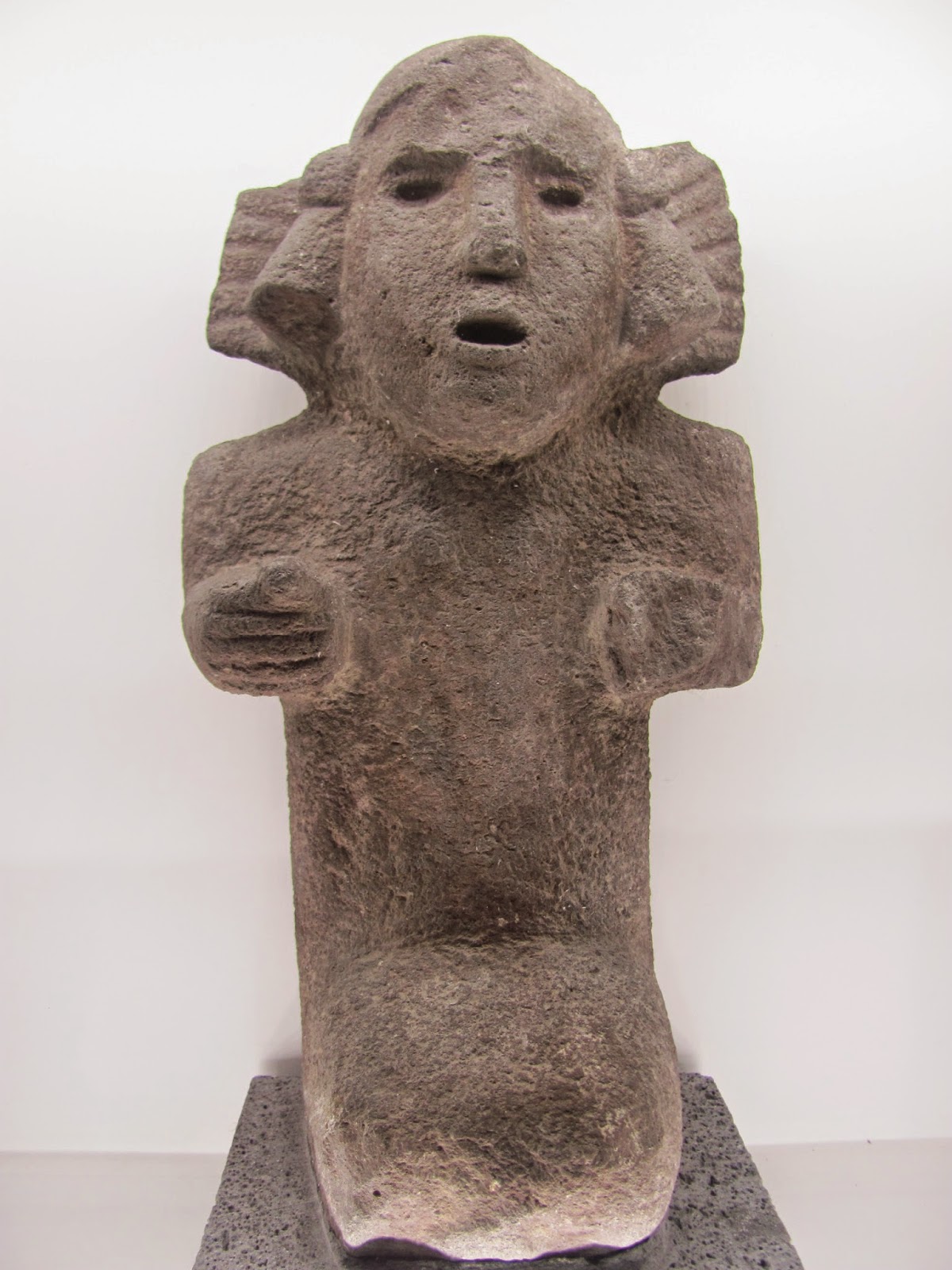
Stone carving, Tamayo Museum, Oaxaca
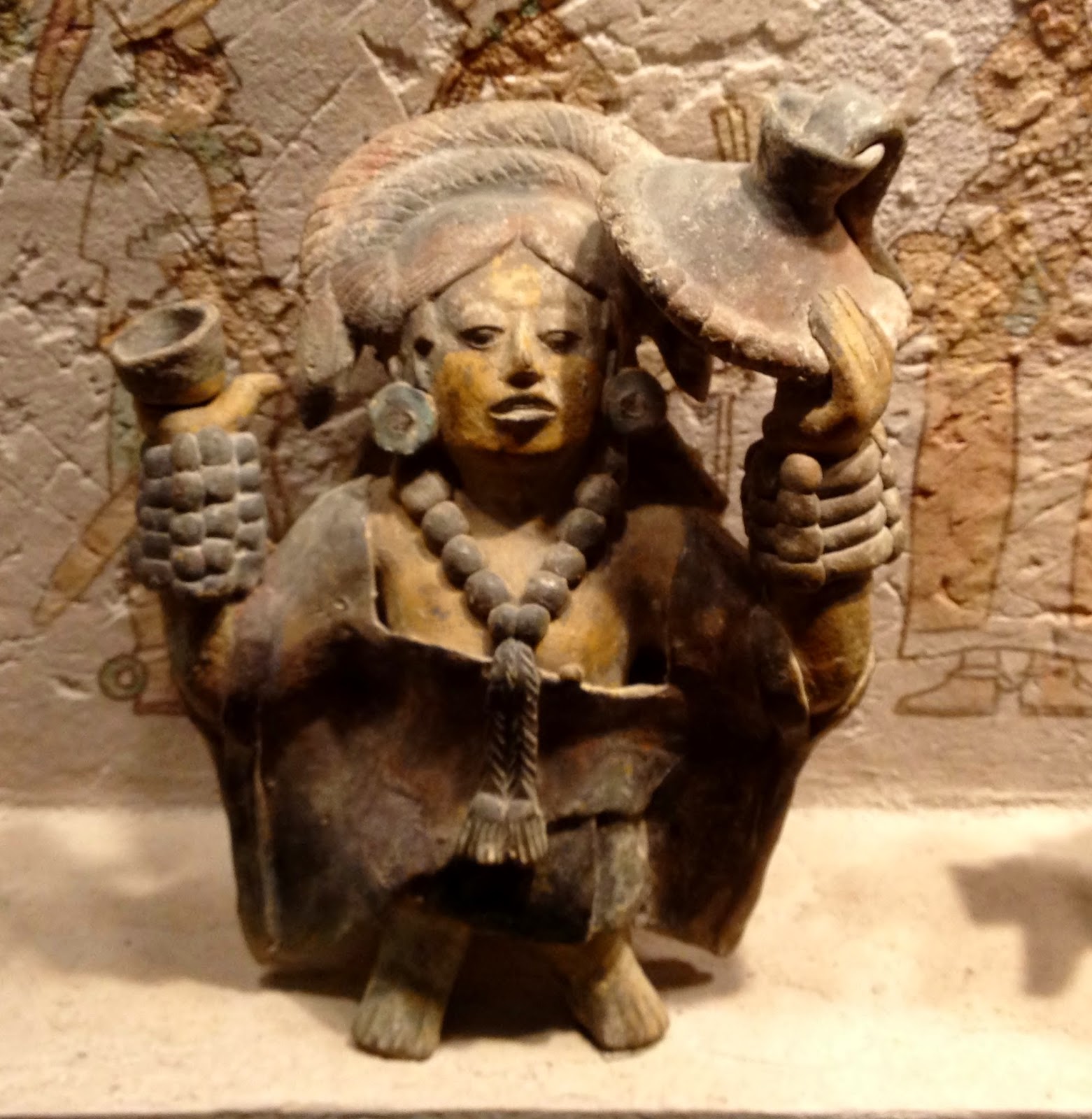
At each of these museums I had the same unexpected experience: Looking at a single object, I was engaged by its specific expression and began to think of its personal history. Some 1500 years ago a person, probably a man, carved the stone  or modeled and carved and fired clay to make one of these figures. I don’t know if he made it for someone to use in daily life or not, but I’m pretty sure it ultimately landed in a tomb, where it would accompany the deceased person for eternity, in the dark and in private. Here he is now, alone, standing on a pedestal in a lavender exhibition case.

Stone sculpture, Anahuacalli
Now I look at these things in brightly lit museum cases, far from the locations and uses for which they were intended. Mostly, I wander past them, giving them a quick admiring or bored glance. But sometimes their intense expressions capture me and I find myself pondering the vicissitudes of their history. I think of them in the dark for 1500 years, then being dug or bulldozed out of their tombs and grabbed up by eager collectors. Treasured by artists who want to share them with everyone and left alone in clean, brightly lit vitrines for another eternity. 
Clay figure, Museum of Anthropology, Mexico City

Although there is information about the general types of the objects and the geographical area where they were probably made, there are no specifics about how and where they were found. At the time Tamayo and Rivera were collecting it was easy to overlook the possibilities that more detailed understanding of the history of the objects might offer. They bought or traded or cajoled these works as gifts, along with the silver entrepreneur William Spratling, the artist Miguel Covarrubias and many others living in Mexico during the 20th century. 

I understand that Rivera and Tamayo thought they were protecting these objects from being “stolen” and taken out of Mexico (while Spratling and other collectors sold some of them to museums in the United States) and indeed they probably were. But they also loved them for their age and beauty, but apparently not for any historical context. And so we don’t usually know much about where, why or how they were buried.