Tuesday, 11 January 2011

December 7, National Gallery, National Portrait Gallery

On my second day I particularly wanted to see the well-received Arcimboldo (1526-1593): Nature and Fantasy show at the National Gallery and the controversial Hide/Seek show at the National Portrait Gallery. But several other exhibitions also called for attention.

Entering the National Gallery through the West Building, again nearest the Metro stop, I wandered through the enticing shops, checking out cards, ties and scarfs, tschotchkes, and the latest art books on the way to the East Building and the Arcimboldo exhibition. To give an engaging context to the few paintings in the show, the curator had chosen to include nature studies, including the fabulous Hans Hoffman Red Squirrel, 1578, a 1526 Durer of cowslips, and several ink caricatures generally attributed to Leonardo. In addition, the exhibition includes publications and drawings, not only of exotic animals but also identifying medicinal plants in carefully illustrated herbaria, 16th-century Italian bronzes of animals and a French Bernard Palissy platter depicting plants and animals. The National Gallery generously provides a lovely illustrated brochure in the exhibition and an illustrated checklist online.  The relatively small gallery reminded one of a Wunderkammer or Studiolo, the cabinets of curiosities sprang up at Renaissance courts.

I've seen paintings attribute to Arcimboldo often in museums and knew some of his works from illustrations, but the extravagantly detailed sea creatures in his Water, 1568, the strangely 20th-century look of Librarian, ca. 1566, and the amusing double images in the three paintings that showed a different aspect of the portrait when turned upside down were all revelations. A lovely video narrated by Isabella Rossellini also gave the exhibition additional context, showing bits of the castles of his major patrons, Maximilian II (1527-1576) in Vienna and Rudolf II (1552-1612) in Prague. But still it consisted of only 16 paintings (checklist total objects: 48) and I went to the bookstore to see if I could get an idea of how many Arcimboldos are actually identified. I still don't know.  I do think that seeing many more would have felt repetitive and tiresome, especially if they were of lesser quality, and that 16 made an excellent revelation of his work and its scholarly and princely context.
Big sign for a small show
The National Gallery was also featuring the Chester Dale Collection, a key component of its 19th-entury painting holdings. I think many works in this exhibition, which meandered through the lower exhibition gallery in the West Building, are not generally on view, and I was really struck by how significantly Chester Dale enhanced the impressionist and other 19th and early 20th century holdings at the National Gallery. One of many examples I enjoyed was a pair of Monet paintings of Rouen Cathedral.


Then, branching off from this exhibition were three more: two of them displaying German drawings, one from the National Gallery collection and the other of works recently acquired from a private collection. The labels indicated that the private collection had been purchased by various patrons rather than donated by the collector. The two included hundreds of drawings, many beautiful, but altogether more than I felt I had the stamina to examine or think about. I stopped at a few of the more beautiful ones, the Friedrichs, a Blecly hen, landscapes by artists whose names I have forgotten, and continued on. But surely this makes the National Gallery a major resource for the study of German drawings, particularly of the 18th and 19th centuries.

The third show was presented as being about the influence of photography on the pre-Raphaelites. The Wall Street Journal recently mentioned this exhibition in a review of the two photography exhibitions in DC in December. I agree with the reviewer that it seems quite unlikely that photograpy could have influenced the painters by offering more detail of observation, since I'm finding more and more that photographs do not usually capture detail with the same attention that painting can. And paintings are in color and early photograpy was not, so it's quite difficult to make a case for photograpy being more realistic. I did find the photographic portraits by Watts quite engaging, was interested to see Julia Margaret Cameon's work looking persistently  more pretentious, and to find through photographs that Rossetti's model looked more like his paintings than one could imagine a real human being could.

On to the National Portrait Gallery, on a cold day, passing a wonderful Mexican restaurant, Oyamel, where we later ate dinner. To get to Hide/Seek, I had to pass through an exhibition of photographs of Elvis Presley taken in 1956, just as he was bursting on the music scene. There was a video of him performing "Blue Suede Shoes" and "Heartbreak Hotel" that brought back memories, although several people my age just passed right though and ignored it.

Hide/Seek: Difference and Desire in American Portraiture, which seems to call attention to the gay and lesbian impact on 20th-century art, is an odd show in juxtapose with Elvis. The exhibition publicity refers to "sexual difference in the making of modern American portraiture," but in other statements their terms are more specifically "gay and lesbian." I had wanted to see it since I'd heard Susan Stamberg talk about it on NPR earlier in the fall, but the protests and removal of the David Wojnarowicz video had made it mandatory. The show was very interesting, but also quite confusing, John O'Hara, Andy Warhol's videos of beautiful people, the Carl van Vechten photograph of Anthony Tudor and Hugh Laing secretly holding hands, Romaine Brooks's self portrait and in drag portrait of Una, Lady Trowbridge, 1924 were all understandable, as were the paired images by Jasper Johns and Robert Rauschenberg. But what's Georgia O'Keeffe doing here and does that slightly female image of a red goat's horn have something to do with portraiture or gayness? Does it really mean the subject is gay if a Grant Wood portrait includes two guys skinny dipping in a rural stream in the background? Was Agnes Martin sexually different in some way because she did self portraits with bare shoulders that she later tried to destroy? I couldn't tell.  Why just show an unfinished Keith Haring and no others? I kept getting sidetracked, wondering what the exhibition was really supposed to be about, at the same time it seemed that just about everybody in the art world was gay, something that shouldn't have been a surprise to me, There certainly were a lot of gay artists and gay subjects, and they certainly did have an important role in the development of some modern art (I don't recall reference to abstract expressionism.).

The exhibition culminates in the age of AIDS, with a few select works, including Robert Mapplethorpe's Self Portrait  and the Felix Gonzales Torres pile of candy in the corner (to be taken away piece by piece, like life). The David Wojnarowicz video would have been essential to that part of the show, since he and his furious reponses to the plight of gay artists in the 80s and early 90s dramatize the agonizing helplessness we in the art world felt as artists and art world leaders succumbed to a disease we couldn't counter. Nonetheless the huge photograph by General Idea, Felix, June 5, 1994, taken hours after Felix Partz's death from an AIDS-related illness made a powerful impact and relived the horror of those times. I'm glad I could see it at the Portrait Gallery, upsetting as it is. The request to remove it in protest to the removal of the Wojanarowitz video also seems totally appropriate and, as a former art museum director and AAMD member, I'm disappointed that the National Portrait Gallery could choose to have a spine in response to the demand of an artist but has none in response to the comment of a legislator. In New York, at the New Museum, I watched a small part of the Wojnarowitz video, didn't have the patience to see it all, but what I saw was clearly not worthy of the exaggerated criticisms of the Catholic whatever it was and any congressman with a sense of honor.

The second bizarre juxtaposition with this show was at the Smithsonian American Art Museum, which is in the same building as the National Portrait Gallery. It was showing Stephen Spielberg and George Lucas's collections of paintings by Norman Rockwell. Despite its persistently uplifting presentation of illusionary small-town life, this show was more appealing to a professional than might have been expected. Rockwell was a wonderful painter and seeing the amazing color combinations in just the skirt of a figure, and the virtuoso brushwork in shaping a face or an arm made it a delight. Spielberg and Lucas also chose some of the more narrative, sometimes amusing but also occasionally more substantive subjects of Rockwell.

Monday, 10 January 2011

December 6, Sackler, Freer, Hirschhorn

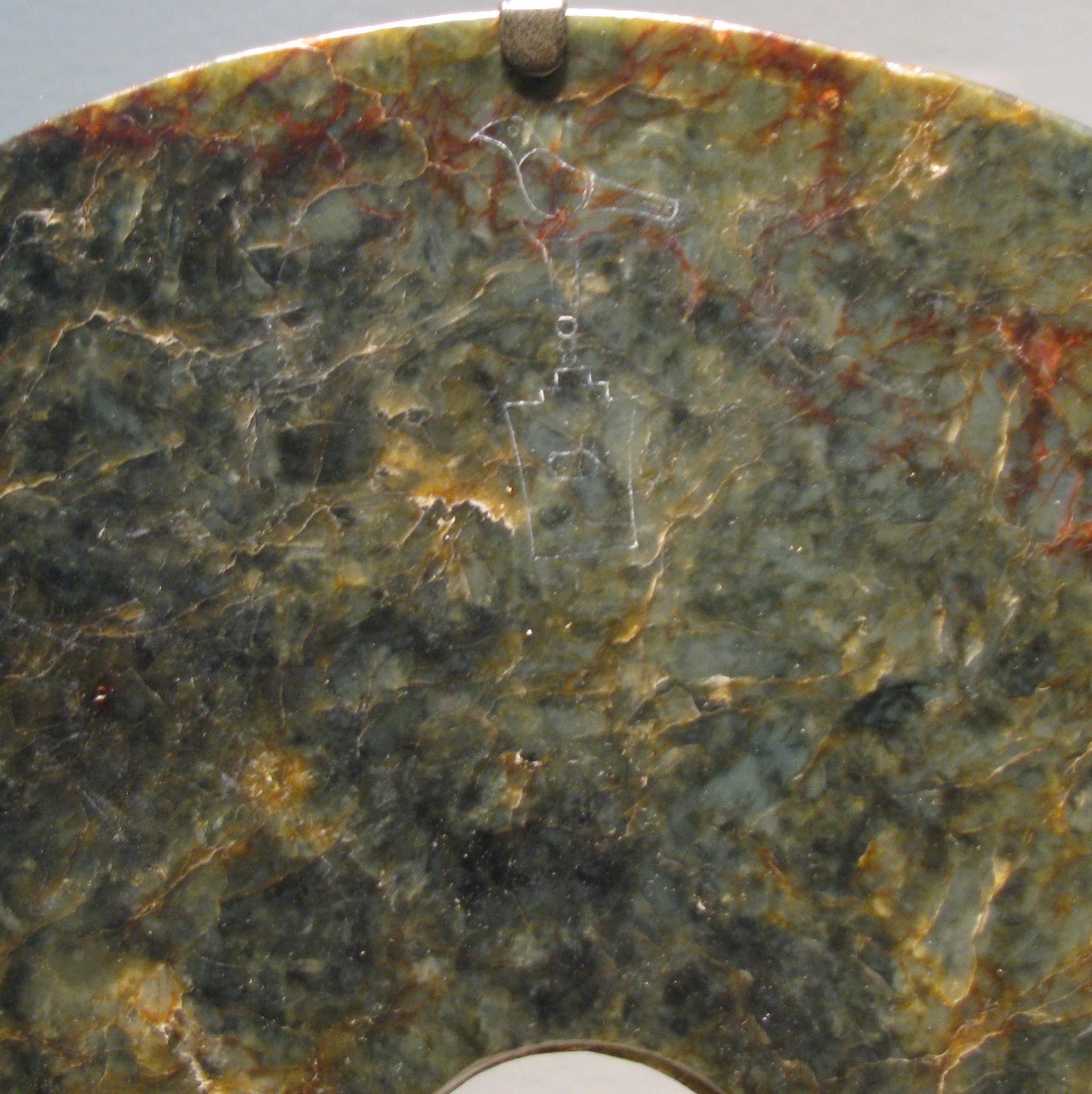
Heading for new exhibitions at the Sackler, I entered through the Freer, which was closer to the Metro Station. I spent hours at the Freer, first admiring and struggling to understand the small exhibition of neolithic jades in shapes the purpose of which seems still to be unknown. Bi, beautiful discs of varied colors of stone and cong, squared vessles from neolithic times were found in profusion in tombs from the Liangzhu culture, dating from 3300 to 2250 BCE.

Cong, often found arranged around the body in tombs
Bi - these are all quite large, too big to wear as pendants

Glyph scratched onto a bi
Next door was a display of the Freer's Chinese bronzes. The only thing I remember from the Chinese Civilization course I took in college is that Shang bronzes have never been equalled in virtuoso casting technique and I've marvelled at the intricate designs on these strangely shaped vessels for decades. A greenish one that combines three animals in this grouping particularly fascinated me.


Ewer in the form of a tiger, owl and water bird, ca. 1300-1200 BCE


Then there was a large and comprehensive exhibition of ceramics from Southern Japan, from Kyushu. There were very few people in the museum and we occasionally commented to each other on how amazing the objects were.


After the obligatory stop in Whistler's Peacock Room, I wandered into galleries with a focus on Whistler's Nocturnes, amazingly modern paintings of atmospheric landscapes, including moody views of London. I was particularly struck by Symphony in Gray: Early Morning Thames, 1871. It seemed totally contemporary, capturing the scene and the feel of the scene in so few details as to approach abstraction but still have substantial narrative content. I've seen the Freer's Whistlers before, but this group seemed especially powerful, innovative and evocative. Later in the Sackler three photographs by Fiona Tan (West Pier Brighton, 2006) reminded me of this painting. There are several images of it on the web, but to me they all look boring and washed out. Seeing it in the frame helps a little, and the dark red walls also helped to focus attention on it.


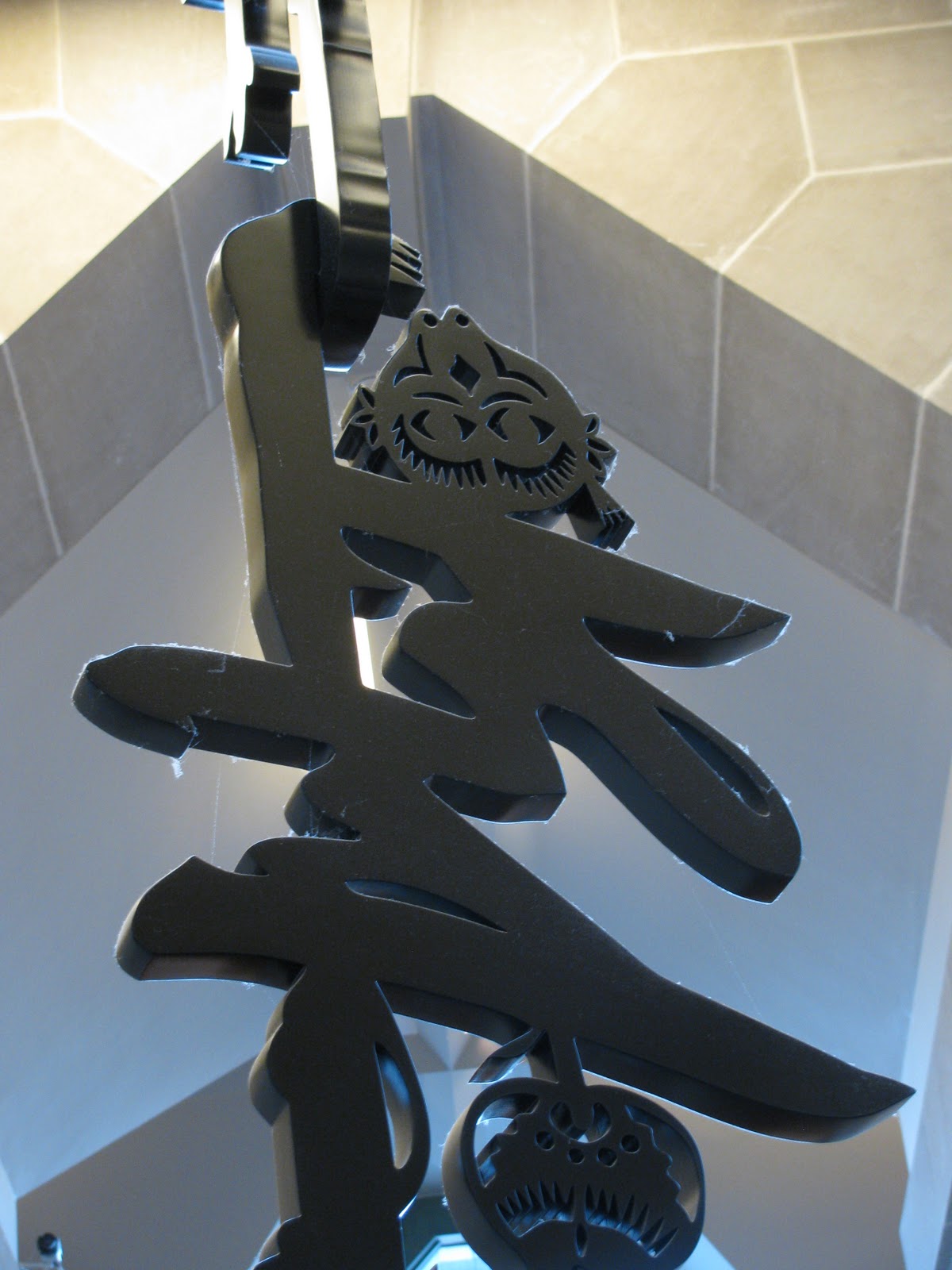
Having recently done some research on contemporary Chinese art for a women's research club I belong to, I wanted to see the Xu Bing Monkeys Reaching for the Moon in the Sackler. It's still a charming manifestation of the concept - a chain of wooden carvings of the word for "monkey" in multiple languages - stretching from the skylight to a reflecting pool at the bottom of the staircase.


I was particularly interested in a show at the Sackler of bronzes from the National Museum of Cambodia, which I visited in 1987, a time when that museum was in poor condition - there were many bats on the ceiling - and I saw for the first time the flowers and coins left by people who still worshipped the Buddhist images on display. The exhibition at the Sackler is relatively small and quite representative, but hardly amazing.

The Sackler also had a small exhibition of the Shahnama, the epic poem of Iran's legendary and quasi-historical story up to the Arab conquest in the seventh century, completed by the Persian poet Abul-Qasim Firdawsi in 1010 CE. As "the most potent expression of Persian literary and national identity to this day," (exhibition brochure), it sparked magnificently illustrated editions commissioned by rulers of the area for centuries. The Sackler exhibition included just a few selected paintings of scenes from the narrative, but by the time I had looked at them, I had a good idea of the gist of the story and had also enjoyed the beauty of their lush detail.

I quickly wandered through the Fiona Tan display, not having patience to give the videos their due, and a show of Chinese objects, watching as a small child ran around the galleries and hid behind the pedestals and I hoped she didn't knock something over. I left before she did. By the time I left, I had spent 5 hours in the museum, admittedly a few minutes of that time captured by a Bollywood video starring Akshay Kumar being played in the museum shop.

Next stop was the Hirschhorn where there was a Guillermo Kuitca exhibition. Kuitca is an artist who has fascinated me for many years. The first works I remember by him were partially obscured maps of places I couldn't identify and so decided they didn't exist. Later I'd seen mattress works and some painted floor plans. My notes indicate that the first work in the exhibition was worth the entire trip. It  is From 1 to 30,000, 1980, ink on canvas of all of those numbers, memorializing the disappeared from Argentina's Dirty War of 1978-1983.

In the Sackler show his maps were mostly on mattresses, and instead of being of obscure places (probably in Poland or Czech Republic) they centered on the stretch of the United States between Kansas City, Oklahoma City to the south and Salina to the west. I could locate Lawrence and Baldwin City! Home!

Much of the work relates to theater in some way. Some dark paintings, suggesting Euro-trash stage sets and titled Seven Last Songs (seems a conflation of Strauss's Four Last Songs and Haydn's Seven Last Words of Christ) suggested a tragic life view, and a recurrent theme of the floor plan of a relatively small house also suggests some sad recollections. Later Kuitca's works depict the insides of historic theaters, using collage rather than painting, sometimes collage black or red lines. The show is huge, with a lot of maps, theater proscenia or floor plans, and floor plans of large institutions. The latter were four of the seven canvases of the Tablada Suite, 1991, acrylic and graphite paintings of detailed floor plans of huge institutions - hospital, prison, cemetary and stadium - on huge soft-toned canvases - buff, gold, lavender and cream. A large composite painting using posters from Wagner's Ring also connects to the theater, as did many of the small works on paper depicting programs and announcements that seemed to have been damaged and distorted by water. At the beginning and end of the show Kuitca included a particularly sterile image of an airport baggage carousel, which he likened to an empty stage in the cell phone voice over. In the end I found many of the works inspiring and thought provoking, but the exhibition went on a little too long.

12 days, 2 museums a day

In early December we spent three days in Washington, DC and another 9 in New York City. Each day I set out to see whatever new exhibitions interested me and by the time I returned to Kansas I could count that I'd been to at least two museums a day. Most days this meant I went to many more than two exhibitions, since the major museums now schedule multiple large exhibitions at a time. I rarely had time to re-visit permanent collections, and in New York especially I skipped perhaps a dozen major venues. In some cases I just glanced at the shows and in others I tried to recod appropriate review materials. But in the end, it seems better to itemize most of what I saw.

One of the larger conclusions I made from this trek was that museums are still making major exhibitions out of rather few objects, for example the National Gallery's Arcimboldo exhibition, which has an enormous banner for a show of 16 paintings, three of which are copies (presumably by the artist). Often the small shows are delightful, informative and envigorating, although occasionally I thought the musuem was making an event from not much. Contrasted to these smaller and often delightful displays are still some extremely large exhibitions that might have benefited by more aggressive editing. Some of these are perfectly enchanting, but others went on well beyond my own ability to stay interested. The obvious conclusion is that the size of an exhibition might well be determined by the type of works being shown, that fewer objects might tell the story more effectively than more, but that any type of object has a critical mass necessary to give it appropriate attention and scholarly weight.

Thursday, 18 November 2010

Wild animals everywhere!


This morning around 9:30 we were in the kitchen and I happened to see something strange in the back yard, near the big oak tree. Our back yard is pretty big and open except for an oak tree and a hickory tree. The thing looked like a sitting animal, but I thought maybe it was a piece of firewood. I asked Tom and he said it was a fox, but then he said, "no....." and ran to get the binoculars. It wasn't a fox; it was a bobcat.

While Tom went to get a camera, I spotted another little one on the side of the yard, and then another big one by the cedar tree at the fenceline. And a little rabbit frozen between them all. Tom got the good camera and I got one reasonable picture of the first cat before they all three ambled away, leaving the rabbit frozen there for another five minutes or so. Tom has never seen an actual bobcat out here in 32 years (he's seen tracks), and I've never seen one either. Here are my pictures:
Kitty, kitty
The rabbit kept really still until a bluejay flew down, I imagined to say that it was all clear, and then she ran, white tail in the air, into the woods.

Rabbit waiting for bobcats to wander away.


Sunday, 14 November 2010

So much can go wrong with apples


Healthy Rome apples

When I first started helping with the apple farm, I was vaguely aware that apples can get worms and something called 'scab,' which I think I knew was a dark hard spot or spots on the apple that made it unattractive and unlikely to sell. Tom told me about cedar-apple rust, which I'd never heard of, this fungus that relies on both apple and cedar trees to exist and can ruin apples. We haven't had much of this at all because Tom sprays regularly for it. But in recent  years I've spent some time on my morning walks with the dogs pulling off the smooth brown rust clumps that are attached to the cedar trees near the orchard. Apparently they die without being on a living cedar, so I hope pulling them off and throwing them in the trash is a bit of additional help for the apples.

But I had no idea of all the ways apples can be damaged, or how to identify that they were damaged. Worms seem often to get into the apple from the flower end and go straight to the core, so you need to watch for little piles of digested apple coming out the flower end. They also sometimes go in through the stem end. And, of course, there are the clear little holes they can make in the side of the apple. Mostly these are the larva of coddling moths, and we're now planning to use traps to be sure we are spraying at the appropriate time to stop them.

Then some years we've had ladybugs setting up housekeeping in the worm- or bird-holes in the apples. They don't seem to initiate damagebut they do eat apples, so it's pretty creepy to find a bunch of them living in the apple you just picked. Speaking of finding insects, I've also had some years when the yellowjackets are a bit of a danger. Either they're on the opposite side of an apple you're about to pick and they sting, or they hang out in the apples that have fallen to the ground, and they get pretty irritated when you step on them. One year I accidentally weed whacked a yellowjacket nest under one of the trees and they chased me to the house. Then a few days later Rosie decided to explore their nest and they chased the dogs AND me to the house. Fortunately, they never nest in the same place twice.

Apple with Sooty Blotch


Same apple after washing with a brush
 The first year we harvested the goldblush apples (a type that doesn't seem to have flourished in the market, but we still love them, crisp and sweet and tart and long-lasting), they had these awful black spots. It looked like they had picked up ash from a fire nearby, but there hadn't been a fire. I figured out that we could scrub the spots off with a brush, but they left the color of the apple uneven. One of my friends suggested that we could market them as a new variety, "Dalmation apples," but we decided not to. So, one day I decided to Google "black spots on apples," and after a little wandering around, I found pictures of Sooty Blotch, a fungal disease that exactly matched our apples. It doesn't damage them, but sure disfigures them. So Tom found an antifungal spray and now we have almost none of it. I still think Sooty Blotch sounds exactly like a character from Dickens, an unscrupulous bookkeeper, or maybe a chimney sweep.

In that same research project, I discovered that "fly speck" is not fly eggs, as Tom had thought, but another type of fungus that can also be eliminated by spraying. Little tiny black spots on the apple, in clusters, usually in conjunction with Sooty Blotch. So those two are out of the way.

Then there are the rots. Mostly we get bitter rot, a dispiriting rotting that starts with a small brown spot and expands to take up the entire apple. This year one of the nearby orchards lost the whole crop to bitter rot. It results from too much warmth and moisture. It's possible to spray for it, but we have not been able to control it completely, and it takes a large percentage of our Fujis each year.

The Jonagolds and some of the goldblushes started showing greenish dents a couple of years ago. Instead of being smooth, the surface of the apple has these uneven spots that are green at the edges and denting the surface. When you peel them, the apple is brown and kind of tough just under the spots, not attractive at all. So last year I went again to Google and discovered cork spot, a phenomenon that is caused by inadequate calcium in the soil. You can either spray the apples or lay limestone down under the trees to eliminate that. Tom chose to spray this year, amused that the spray he used was calcium chloride, often used for snow melt. He had to be careful because the stuff can corrode the sprayer. But the spraying eliminated most of the cork spot, making the Jonagolds much prettier this year. But they still had a lot of bitter rot, so we still have work to do.

This year was particularly wet and then especially hot in summer, encouraging all kinds of fungus growth. Another one is called fire blight. The branches of the trees look like they've been burned. When the trees are in leaf, fire blight looks like the branch has suddenly died, with the leaves brown and drooping. It's been slowly advancing in the orchard and I'm pretty worried about it. The main way to control it, if you don't want to use antibiotics (and we don't), is to cut off the damaged branches and take them away, sterilizing your clippers each time you cut off a branch. It's really time-consuming, but seems important to do this year.

Once these things have "gotten" an apple, there's nothing to do but knock it off for the deer or pick it and use the good parts. You can't repair them; you just have to try again next year.

The McIntosh trees are another matter. They get all the diseases, but it hardly matters because in the heat of Kansas, most of them fall off the tree weeks before they get ripe. Every time we decide to chop them down and plant something else, we hear or read about someone who just loves McIntosh apples.

We're not completely safe during the winter either. Last winter the rabbits ate the bark all around the bottoms of several of our small trees, and they were dead by spring. We got protective shields for them and this year the remaining trees should be safe. The shields also protect the little trees against me with the weed whacker. The deer damage trees rubbing their horns on the branches. Our dogs and cats are supposed to chase the deer and eat the rabbits, but they don't range far enough to get them all. We also spotted voles last year, but we don't think they're getting the trees yet - they eat vegetation. And the cats might actually have an effect on them.

I think I imagined that apples grow easily with little attention from anyone, but every year another threat appears for them.


Baby mourning doves in a Rome apple tree, 2009


Thursday, 11 November 2010

Beaver!

We have a 38-year old horse named Champagne, who lives on about 50 acres of fenced in land with a large pond, lots of trees, and some grass. We feed her daily. About 10 days ago we noticed that her food wasn't disappearing and we hadn't seen her for a day or so, so on the weekend we decided to look for her. It didn't take long to find her near the pond, standing in some very lush-looking grass. As long as we were there, we took a look at the pond, which we visit relatively infrequently. I noticed a few small trees that had been chopped down and then a pile of large sticks on the side of the pond with some mud and leaves on top of it.

The dogs seemed interested in the pile and we figured it was a beaver home, so we pulled some of the sticks out to encourage the dogs. Nothing happened, so we checked out the dam, found some larger trees with those distinctive beaver tooth marks (I only know about this from cartoons, actually) and figured there's got to be a beaver around. We went back to the house.
 
Then I started to hear Thunder, the huskie, barking. And barking, and barking. After maybe two hours, I decided I had to go see what was going on and found him at the edge of the pond while a very large beaver was calmly swimming back and forth in front of him. Thunder and Rosie don't know they can swim, which is probably a good thing, but Thunder really wanted this beaver for something or other. Fortunately, he stayed on or really near the shore and didn't tangle with the big thing. But we did get some pictures.
  
 
This is my Blackberry picture. The beaver is the spot in the calm water just about dead center in the picture.

 
Tom brought a better camera

We've only seen one, but can't imagine he, or she, lives there alone.

Apple season review

Apple picking  season ended last week, way later than we expected. The winesaps, which started ripening much earlier than usual (along with all the other apples), stayed small and so we had to wait for them to get big enough and picked them in phases. By now the few that are left are just tiny and the weather's too cold for them to get big enough to sell.

We had a reasonable crop this year, but not an outstanding one. Many growers in this area lost most of their crop to fungus diseases and we had our share, but we ended up with about 5 tons of good, salable apples. We've been selling them to the local discount grocery store, Checkers, which has an excellent array of local products, great produce, and more interesting gourmet items than you would expect from the look of the place, a kind of warehouse style. Late in the season, the Community Mercantile - the organic and health food store - asked for apples and we sent them some winesaps. And two local restaurants and a local pie maker have been using our apples pretty regularly. At 715 (715 Massachusetts), a fairly new restaurant in Lawrence that patronizes many local food suppliers, we were surprised and delighted to find "Beisecker Farms Apple Crumble" on the dessert menu, and I had some lovely salads there with apple slivers included. They will continue to have our apples through November, at least.
 
Here's the apple sorting room in action. We bag and weigh them on the table in the foreground. Tom's son David made the table, I think in high school. He's a philosophy professor now.

Galas, washed, but not sorted yet

Apple washing and sorting apparatus. The "seconds" are in the front bins.


We started using this equipment last year in the garage, but now it's neatly installed in the refurbished barn(notice the nice light walls). We got it second hand from Mr. and Mrs. Speer, some lovely people in Arkansas City who were retiring their orchard. Sadly, we didn't get their donut maker. The washer seems to have been manufactured around 1962, the date of the instruction booklet, and the sorter maybe 20 years later. The Speers got the equipment from Pool's Orchard in Arkansas City. Pool's purchased the sorter at an auction in 1985. All of it works beautifully and is far better than the washing, polishing and sorting that we used to do in the kitchen.

Here is a picture of the galas just after they were picked, August 20.


And here are the later season Fujis and winesaps