In early December we spent three days in Washington, DC and another 9 in New York City. Each day I set out to see whatever new exhibitions interested me and by the time I returned to Kansas I could count that I'd been to at least two museums a day. Most days this meant I went to many more than two exhibitions, since the major museums now schedule multiple large exhibitions at a time. I rarely had time to re-visit permanent collections, and in New York especially I skipped perhaps a dozen major venues. In some cases I just glanced at the shows and in others I tried to recod appropriate review materials. But in the end, it seems better to itemize most of what I saw.
One of the larger conclusions I made from this trek was that museums are still making major exhibitions out of rather few objects, for example the National Gallery's Arcimboldo exhibition, which has an enormous banner for a show of 16 paintings, three of which are copies (presumably by the artist). Often the small shows are delightful, informative and envigorating, although occasionally I thought the musuem was making an event from not much. Contrasted to these smaller and often delightful displays are still some extremely large exhibitions that might have benefited by more aggressive editing. Some of these are perfectly enchanting, but others went on well beyond my own ability to stay interested. The obvious conclusion is that the size of an exhibition might well be determined by the type of works being shown, that fewer objects might tell the story more effectively than more, but that any type of object has a critical mass necessary to give it appropriate attention and scholarly weight.
Monday, 10 January 2011


Thursday, 18 November 2010
Wild animals everywhere!
This morning around 9:30 we were in the kitchen and I happened to see something strange in the back yard, near the big oak tree. Our back yard is pretty big and open except for an oak tree and a hickory tree. The thing looked like a sitting animal, but I thought maybe it was a piece of firewood. I asked Tom and he said it was a fox, but then he said, "no....." and ran to get the binoculars. It wasn't a fox; it was a bobcat.
While Tom went to get a camera, I spotted another little one on the side of the yard, and then another big one by the cedar tree at the fenceline. And a little rabbit frozen between them all. Tom got the good camera and I got one reasonable picture of the first cat before they all three ambled away, leaving the rabbit frozen there for another five minutes or so. Tom has never seen an actual bobcat out here in 32 years (he's seen tracks), and I've never seen one either. Here are my pictures:
 |
| Kitty, kitty |
The rabbit kept really still until a bluejay flew down, I imagined to say that it was all clear, and then she ran, white tail in the air, into the woods.
 |
Rabbit waiting for bobcats to wander away. |
Sunday, 14 November 2010
So much can go wrong with apples
The first year we harvested the goldblush apples (a type that doesn't seem to have flourished in the market, but we still love them, crisp and sweet and tart and long-lasting), they had these awful black spots. It looked like they had picked up ash from a fire nearby, but there hadn't been a fire. I figured out that we could scrub the spots off with a brush, but they left the color of the apple uneven. One of my friends suggested that we could market them as a new variety, "Dalmation apples," but we decided not to. So, one day I decided to Google "black spots on apples," and after a little wandering around, I found pictures of Sooty Blotch, a fungal disease that exactly matched our apples. It doesn't damage them, but sure disfigures them. So Tom found an antifungal spray and now we have almost none of it. I still think Sooty Blotch sounds exactly like a character from Dickens, an unscrupulous bookkeeper, or maybe a chimney sweep.
In that same research project, I discovered that "fly speck" is not fly eggs, as Tom had thought, but another type of fungus that can also be eliminated by spraying. Little tiny black spots on the apple, in clusters, usually in conjunction with Sooty Blotch. So those two are out of the way.
Then there are the rots. Mostly we get bitter rot, a dispiriting rotting that starts with a small brown spot and expands to take up the entire apple. This year one of the nearby orchards lost the whole crop to bitter rot. It results from too much warmth and moisture. It's possible to spray for it, but we have not been able to control it completely, and it takes a large percentage of our Fujis each year.
The Jonagolds and some of the goldblushes started showing greenish dents a couple of years ago. Instead of being smooth, the surface of the apple has these uneven spots that are green at the edges and denting the surface. When you peel them, the apple is brown and kind of tough just under the spots, not attractive at all. So last year I went again to Google and discovered cork spot, a phenomenon that is caused by inadequate calcium in the soil. You can either spray the apples or lay limestone down under the trees to eliminate that. Tom chose to spray this year, amused that the spray he used was calcium chloride, often used for snow melt. He had to be careful because the stuff can corrode the sprayer. But the spraying eliminated most of the cork spot, making the Jonagolds much prettier this year. But they still had a lot of bitter rot, so we still have work to do.
This year was particularly wet and then especially hot in summer, encouraging all kinds of fungus growth. Another one is called fire blight. The branches of the trees look like they've been burned. When the trees are in leaf, fire blight looks like the branch has suddenly died, with the leaves brown and drooping. It's been slowly advancing in the orchard and I'm pretty worried about it. The main way to control it, if you don't want to use antibiotics (and we don't), is to cut off the damaged branches and take them away, sterilizing your clippers each time you cut off a branch. It's really time-consuming, but seems important to do this year.
Once these things have "gotten" an apple, there's nothing to do but knock it off for the deer or pick it and use the good parts. You can't repair them; you just have to try again next year.
The McIntosh trees are another matter. They get all the diseases, but it hardly matters because in the heat of Kansas, most of them fall off the tree weeks before they get ripe. Every time we decide to chop them down and plant something else, we hear or read about someone who just loves McIntosh apples.
We're not completely safe during the winter either. Last winter the rabbits ate the bark all around the bottoms of several of our small trees, and they were dead by spring. We got protective shields for them and this year the remaining trees should be safe. The shields also protect the little trees against me with the weed whacker. The deer damage trees rubbing their horns on the branches. Our dogs and cats are supposed to chase the deer and eat the rabbits, but they don't range far enough to get them all. We also spotted voles last year, but we don't think they're getting the trees yet - they eat vegetation. And the cats might actually have an effect on them.
 |
| Healthy Rome apples |
When I first started helping with the apple farm, I was vaguely aware that apples can get worms and something called 'scab,' which I think I knew was a dark hard spot or spots on the apple that made it unattractive and unlikely to sell. Tom told me about cedar-apple rust, which I'd never heard of, this fungus that relies on both apple and cedar trees to exist and can ruin apples. We haven't had much of this at all because Tom sprays regularly for it. But in recent years I've spent some time on my morning walks with the dogs pulling off the smooth brown rust clumps that are attached to the cedar trees near the orchard. Apparently they die without being on a living cedar, so I hope pulling them off and throwing them in the trash is a bit of additional help for the apples.
But I had no idea of all the ways apples can be damaged, or how to identify that they were damaged. Worms seem often to get into the apple from the flower end and go straight to the core, so you need to watch for little piles of digested apple coming out the flower end. They also sometimes go in through the stem end. And, of course, there are the clear little holes they can make in the side of the apple. Mostly these are the larva of coddling moths, and we're now planning to use traps to be sure we are spraying at the appropriate time to stop them.
Then some years we've had ladybugs setting up housekeeping in the worm- or bird-holes in the apples. They don't seem to initiate damagebut they do eat apples, so it's pretty creepy to find a bunch of them living in the apple you just picked. Speaking of finding insects, I've also had some years when the yellowjackets are a bit of a danger. Either they're on the opposite side of an apple you're about to pick and they sting, or they hang out in the apples that have fallen to the ground, and they get pretty irritated when you step on them. One year I accidentally weed whacked a yellowjacket nest under one of the trees and they chased me to the house. Then a few days later Rosie decided to explore their nest and they chased the dogs AND me to the house. Fortunately, they never nest in the same place twice.
 |
| Apple with Sooty Blotch |
 |
| Same apple after washing with a brush |
In that same research project, I discovered that "fly speck" is not fly eggs, as Tom had thought, but another type of fungus that can also be eliminated by spraying. Little tiny black spots on the apple, in clusters, usually in conjunction with Sooty Blotch. So those two are out of the way.
Then there are the rots. Mostly we get bitter rot, a dispiriting rotting that starts with a small brown spot and expands to take up the entire apple. This year one of the nearby orchards lost the whole crop to bitter rot. It results from too much warmth and moisture. It's possible to spray for it, but we have not been able to control it completely, and it takes a large percentage of our Fujis each year.
The Jonagolds and some of the goldblushes started showing greenish dents a couple of years ago. Instead of being smooth, the surface of the apple has these uneven spots that are green at the edges and denting the surface. When you peel them, the apple is brown and kind of tough just under the spots, not attractive at all. So last year I went again to Google and discovered cork spot, a phenomenon that is caused by inadequate calcium in the soil. You can either spray the apples or lay limestone down under the trees to eliminate that. Tom chose to spray this year, amused that the spray he used was calcium chloride, often used for snow melt. He had to be careful because the stuff can corrode the sprayer. But the spraying eliminated most of the cork spot, making the Jonagolds much prettier this year. But they still had a lot of bitter rot, so we still have work to do.
This year was particularly wet and then especially hot in summer, encouraging all kinds of fungus growth. Another one is called fire blight. The branches of the trees look like they've been burned. When the trees are in leaf, fire blight looks like the branch has suddenly died, with the leaves brown and drooping. It's been slowly advancing in the orchard and I'm pretty worried about it. The main way to control it, if you don't want to use antibiotics (and we don't), is to cut off the damaged branches and take them away, sterilizing your clippers each time you cut off a branch. It's really time-consuming, but seems important to do this year.
Once these things have "gotten" an apple, there's nothing to do but knock it off for the deer or pick it and use the good parts. You can't repair them; you just have to try again next year.
The McIntosh trees are another matter. They get all the diseases, but it hardly matters because in the heat of Kansas, most of them fall off the tree weeks before they get ripe. Every time we decide to chop them down and plant something else, we hear or read about someone who just loves McIntosh apples.
We're not completely safe during the winter either. Last winter the rabbits ate the bark all around the bottoms of several of our small trees, and they were dead by spring. We got protective shields for them and this year the remaining trees should be safe. The shields also protect the little trees against me with the weed whacker. The deer damage trees rubbing their horns on the branches. Our dogs and cats are supposed to chase the deer and eat the rabbits, but they don't range far enough to get them all. We also spotted voles last year, but we don't think they're getting the trees yet - they eat vegetation. And the cats might actually have an effect on them.
I think I imagined that apples grow easily with little attention from anyone, but every year another threat appears for them.
 |
| Baby mourning doves in a Rome apple tree, 2009 |
Thursday, 11 November 2010
Beaver!
We have a 38-year old horse named Champagne, who lives on about 50 acres of fenced in land with a large pond, lots of trees, and some grass. We feed her daily. About 10 days ago we noticed that her food wasn't disappearing and we hadn't seen her for a day or so, so on the weekend we decided to look for her. It didn't take long to find her near the pond, standing in some very lush-looking grass. As long as we were there, we took a look at the pond, which we visit relatively infrequently. I noticed a few small trees that had been chopped down and then a pile of large sticks on the side of the pond with some mud and leaves on top of it.
The dogs seemed interested in the pile and we figured it was a beaver home, so we pulled some of the sticks out to encourage the dogs. Nothing happened, so we checked out the dam, found some larger trees with those distinctive beaver tooth marks (I only know about this from cartoons, actually) and figured there's got to be a beaver around. We went back to the house.
Then I started to hear Thunder, the huskie, barking. And barking, and barking. After maybe two hours, I decided I had to go see what was going on and found him at the edge of the pond while a very large beaver was calmly swimming back and forth in front of him. Thunder and Rosie don't know they can swim, which is probably a good thing, but Thunder really wanted this beaver for something or other. Fortunately, he stayed on or really near the shore and didn't tangle with the big thing. But we did get some pictures.
The dogs seemed interested in the pile and we figured it was a beaver home, so we pulled some of the sticks out to encourage the dogs. Nothing happened, so we checked out the dam, found some larger trees with those distinctive beaver tooth marks (I only know about this from cartoons, actually) and figured there's got to be a beaver around. We went back to the house.
Then I started to hear Thunder, the huskie, barking. And barking, and barking. After maybe two hours, I decided I had to go see what was going on and found him at the edge of the pond while a very large beaver was calmly swimming back and forth in front of him. Thunder and Rosie don't know they can swim, which is probably a good thing, but Thunder really wanted this beaver for something or other. Fortunately, he stayed on or really near the shore and didn't tangle with the big thing. But we did get some pictures.
 |
| This is my Blackberry picture. The beaver is the spot in the calm water just about dead center in the picture. |
 |
| Tom brought a better camera |
We've only seen one, but can't imagine he, or she, lives there alone.
Apple season review
Apple picking season ended last week, way later than we expected. The winesaps, which started ripening much earlier than usual (along with all the other apples), stayed small and so we had to wait for them to get big enough and picked them in phases. By now the few that are left are just tiny and the weather's too cold for them to get big enough to sell.
We had a reasonable crop this year, but not an outstanding one. Many growers in this area lost most of their crop to fungus diseases and we had our share, but we ended up with about 5 tons of good, salable apples. We've been selling them to the local discount grocery store, Checkers, which has an excellent array of local products, great produce, and more interesting gourmet items than you would expect from the look of the place, a kind of warehouse style. Late in the season, the Community Mercantile - the organic and health food store - asked for apples and we sent them some winesaps. And two local restaurants and a local pie maker have been using our apples pretty regularly. At 715 (715 Massachusetts), a fairly new restaurant in Lawrence that patronizes many local food suppliers, we were surprised and delighted to find "Beisecker Farms Apple Crumble" on the dessert menu, and I had some lovely salads there with apple slivers included. They will continue to have our apples through November, at least.
We started using this equipment last year in the garage, but now it's neatly installed in the refurbished barn(notice the nice light walls). We got it second hand from Mr. and Mrs. Speer, some lovely people in Arkansas City who were retiring their orchard. Sadly, we didn't get their donut maker. The washer seems to have been manufactured around 1962, the date of the instruction booklet, and the sorter maybe 20 years later. The Speers got the equipment from Pool's Orchard in Arkansas City. Pool's purchased the sorter at an auction in 1985. All of it works beautifully and is far better than the washing, polishing and sorting that we used to do in the kitchen.
Here is a picture of the galas just after they were picked, August 20.


We had a reasonable crop this year, but not an outstanding one. Many growers in this area lost most of their crop to fungus diseases and we had our share, but we ended up with about 5 tons of good, salable apples. We've been selling them to the local discount grocery store, Checkers, which has an excellent array of local products, great produce, and more interesting gourmet items than you would expect from the look of the place, a kind of warehouse style. Late in the season, the Community Mercantile - the organic and health food store - asked for apples and we sent them some winesaps. And two local restaurants and a local pie maker have been using our apples pretty regularly. At 715 (715 Massachusetts), a fairly new restaurant in Lawrence that patronizes many local food suppliers, we were surprised and delighted to find "Beisecker Farms Apple Crumble" on the dessert menu, and I had some lovely salads there with apple slivers included. They will continue to have our apples through November, at least.
 |
| Here's the apple sorting room in action. We bag and weigh them on the table in the foreground. Tom's son David made the table, I think in high school. He's a philosophy professor now. |
 |
| Galas, washed, but not sorted yet |
 |
| Apple washing and sorting apparatus. The "seconds" are in the front bins. |
We started using this equipment last year in the garage, but now it's neatly installed in the refurbished barn(notice the nice light walls). We got it second hand from Mr. and Mrs. Speer, some lovely people in Arkansas City who were retiring their orchard. Sadly, we didn't get their donut maker. The washer seems to have been manufactured around 1962, the date of the instruction booklet, and the sorter maybe 20 years later. The Speers got the equipment from Pool's Orchard in Arkansas City. Pool's purchased the sorter at an auction in 1985. All of it works beautifully and is far better than the washing, polishing and sorting that we used to do in the kitchen.
Here is a picture of the galas just after they were picked, August 20.

And here are the later season Fujis and winesaps

Tuesday, 5 October 2010
Elizabeth Turk
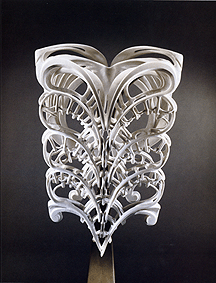
Elizabeth Turk got a MacArthur prize! In 2006 we saw her exhibition at Hirschl and Adler gallery of collars made of elaborately, impossibly carved white marble. We were amazed at her virtuosity. I wrote briefly about her in the August 2006 issue of Kansas City's Review magazine.
 As a person with a Ph.D. in Italian Renaissance sculpture, I first connected her to the 16th-century Milanese virtuoso artist Augustino Busti, called Il Bambaia, whose extraordinarily high relief and detailed sculptures amazed me many years ago. Many of his works were vandalized by having their tiny heads pulled off.
 Of course, for virtuoso marble carving, Gianlorenzo Bernini is the first name that comes to mind, but Turk's work is far more adventurous than even his. Her collars are like lace, vines, skeletons, or DNA models, all of which inspire her. Two of the collars referred to 9/11, with plan and flower forms entwined around skeletal ones. I thought the combination of fragility and strength in the same sculpture had some of the tough delicacy of Petah Coyne's wax chandeliers.

Saturday, 2 October 2010
Why is contemporary art so challenging?
When I was thinking about what to say about Ann Hamilton, I heard a discussion on the radio by arts professionals trying to guide a general audience as to how they can appreciate contemporary art. The speakers confirmed that reading about art, looking at as much art as possible, and keeping an open mind, are helpful in appreciating what we see. They also recommended reading about the artists specifically to understand their intentions. It was when the professionals started talking about the difficulties many people have appreciating performance art that I started thinking about how the idea of art has expanded so dramatically in the last, say 50 years. And I don't think the other arts, performing or literary, have taken such diverse paths as have visual arts.
You can still go into a museum or gallery and expect to see paintings on the wall and sculptures on the floor, or wall. And there are prints and drawings and photographs. These aspects of visual art continue. as do public art installations outside the museum context. But, and Tom and I often disagree about this, artists can conceive projects which have no physical components, no objects, just an idea or an action. Many of them use found objects, but also found or created sounds, words, their own bodies, actions as art. To some extent I think some artists struggle to see how far removed their creations can be from the standard media of visual art. Artist do performances; actors do not display paintings on stage. Marina Abramovic sat in a chair at the Museum of Modern Art in New York and faced visitors who chose to sit opposite her. It's unlikely that this would happen in a theater and it would not have the same impact in the context of theater. Sophie Calle asked distinguished women to respond to her boyfriend's breakup email ("Take care of yourself") in the French Pavilion of the 2006 Venice Biennale. It might have been a book, but had to be an art installation (that kept the female audience, myself included, engrossed for hours while their male companions [mine too] waited outside).
Artists do video and film and also use video and film in installations (Nam Jun Paik for example) but videographers and film makers don't replace their works with objects. You still go to the theater and usually sit and watch a play, a movie, or a music performance. But going to a museum can also involve listening to musical sounds, as at the Ann Hamilton show, reading texts, seeing documentation about Tehching Tsieh, who spent a year living in a cage as a work of art, or seeing a preserved shark in a tank of formaldehyde (or its replacement). Writers may use the internet to communicate and they may write with computers rather than a quill pen, but words are still their tools. Artists also use words, as Ann Hamilton does in many parts of her Pulitzer installation, as On Kawara has with his date paintings or as Jenny Holzer does, often using LED displays. The opportunities for visual artists to expand their media and their conceptualization of what they do seem to be limitless, while those who work in the other arts seem primarily to have remained committed to their original discipline, media and basic materials.
That the possibilities are so open for visual artists is a wonderful, exciting thing to think about. But it also makes it quite difficult for anyone - including specialists - to evaluate or understand their work, to have the patience to give it adequate attention, to suspend disbelief long enough to give it a chance to reverberate with their experience and expectations, and to question intelligently whether what the artist is doing has any real worth beyond being different. It will take decades. In the meantime visual artists continue to explore an unprecedented variety of media and methods.
You can still go into a museum or gallery and expect to see paintings on the wall and sculptures on the floor, or wall. And there are prints and drawings and photographs. These aspects of visual art continue. as do public art installations outside the museum context. But, and Tom and I often disagree about this, artists can conceive projects which have no physical components, no objects, just an idea or an action. Many of them use found objects, but also found or created sounds, words, their own bodies, actions as art. To some extent I think some artists struggle to see how far removed their creations can be from the standard media of visual art. Artist do performances; actors do not display paintings on stage. Marina Abramovic sat in a chair at the Museum of Modern Art in New York and faced visitors who chose to sit opposite her. It's unlikely that this would happen in a theater and it would not have the same impact in the context of theater. Sophie Calle asked distinguished women to respond to her boyfriend's breakup email ("Take care of yourself") in the French Pavilion of the 2006 Venice Biennale. It might have been a book, but had to be an art installation (that kept the female audience, myself included, engrossed for hours while their male companions [mine too] waited outside).
Artists do video and film and also use video and film in installations (Nam Jun Paik for example) but videographers and film makers don't replace their works with objects. You still go to the theater and usually sit and watch a play, a movie, or a music performance. But going to a museum can also involve listening to musical sounds, as at the Ann Hamilton show, reading texts, seeing documentation about Tehching Tsieh, who spent a year living in a cage as a work of art, or seeing a preserved shark in a tank of formaldehyde (or its replacement). Writers may use the internet to communicate and they may write with computers rather than a quill pen, but words are still their tools. Artists also use words, as Ann Hamilton does in many parts of her Pulitzer installation, as On Kawara has with his date paintings or as Jenny Holzer does, often using LED displays. The opportunities for visual artists to expand their media and their conceptualization of what they do seem to be limitless, while those who work in the other arts seem primarily to have remained committed to their original discipline, media and basic materials.
That the possibilities are so open for visual artists is a wonderful, exciting thing to think about. But it also makes it quite difficult for anyone - including specialists - to evaluate or understand their work, to have the patience to give it adequate attention, to suspend disbelief long enough to give it a chance to reverberate with their experience and expectations, and to question intelligently whether what the artist is doing has any real worth beyond being different. It will take decades. In the meantime visual artists continue to explore an unprecedented variety of media and methods.
Subscribe to:
Posts (Atom)

