I still remember jokes that puzzled me in my youth and I only figured out some 10 or 20 years later. Similarly, sometimes it takes a while to grasp what is going on in an exhibition. So perhaps the Ann Hamilton exhibition we saw at the Pulitzer Foundation in St. Louis in August will suddenly be revealed to me in due time. I’ve been fascinated by Ann Hamilton and what she says about her work, the depth, thoughtfulness, and philosophical approach she takes, as well as by the respect she has earned from the art world, evidenced by the Pulitzer’s choice of her for their first artist installation exhibition.
However, the only work I’ve seen by her, her installation at the 1999 Venice Biennale, did not elicit a good response from me. I remember being fascinated and delighted by pink powder floating down the walls and piling up at the edges of the floor of the American Pavilion. But when I - and my two companions - read the label, which explained that the point of the installation was to demonstrate how difficult it is for people to communicate with each other, all three of us walked out, not just puzzled, but infuriated. I don’t know about them, but I was angry that such a lovely abstract environment was loaded with such complicated non-visual content and that the content was totally inaccessible without the label, although having read the explanation, one still didn’t really “see” the meaning she intended to convey. There was more to it: I think a recording a man reading the Declaration of Independence that had been slowed down to sound like a low growl and Braille inscriptions on the walls.
We went to the Pulitzer with curiosity and with fairly open minds, despite this previous disappointment. The Pulitzer is an eccentric institution, open only two days a week (now expanded to include Thursday evenings). So it was not unusual that the attendant at the desk explained a bit about the show and asked us to sign in. When we signed the register, we heard a discordant possibly musical sound coming from far away.
A second attendant asked us to choose a record from a file of unlabeled records. We each took one and she played them while she explained the weekly newspaper-like concordance-related publications Hamilton is producing for the exhibition. Each week she gathers from English-language newspapers around the world phrases containing a word she has chosen from a statement of purpose (we never found the statement). Our week the word was “Be.” The phrases were listed with the chosen word in a column down the center of the page. For $2 we purchased the concordance from August 6 that used “Reveal, Say, Sing, Singing, Song Speak, Speaking, State, Suggest, Tell, Utter, Voice, and World,” much more interesting than “Be,” but nonsensical nonetheless. On the wall behind the record player and the concordance is a video of an arm waving back and forth.
In the big gallery were metal staircases with projectors on top, some of which revolved. They showed fuzzy, vague images mostly of a pencil point moving on paper, sometimes with accompanying scratchy sounds. You could also heard sounds coming from microphones under the air handling system vents that run along the floor of the building. Shelves occupied one very long wall, that square shelving you often see in museum shops because it holds both books and objects well. Maybe 300 shelves, each with two or more papier maché hands, all in shades of beige and taupe. The attendant suggests that you may touch or try on the hands. I tried moving them around; I couldn’t fit my hand into them. Following the shelves down the wall you come to a small gallery with a piano inside, which you are welcome to play.
Going downstairs, we watched another attendant playing with a gadget that had four little metal balls on a small platform. She was busily rotating the platform so the balls rolled around on it. A microphone caught the sound of the balls rolling and magnified and broadcast it. If the attendant touched the microphone one of the pianos would play a few notes. She encouraged us to play with this gadget, which she was only demonstrating. She explained also that there is a second piano in the downstairs gallery and the two pianos are somehow connected so that sometimes playing one will activate the other. People signing in activate them also, as did touching her microphone.
On the top floor is a large table covered with Mexican jumping beans and microphones to catch the sound when they jump. The attendant here explained that the jumping beans are refrigerated when the gallery is closed, and that there are two sets, so one is kept cool while the other is on view, in order to give them rest and delay hatching. She also explained that we could read the concordance into a microphone in that area that I imagine would broadcast through the museum, but we didn’t try it. She said the jumping beans are the only thing in the installation that visitors may not touch.
I had noticed loudspeakers outside the building that broadcast someone saying something, just one sentence. We were given the opportunity to record something for broadcast, but chose not to. As I said to the attendant, I’m really used to not touching works of art and generally prefer not to be part of an art installation, but rather to look at it from outside. Perhaps my reticence is what the exhibition is trying to counter.
So, thinking about the installation in Venice, I figure this exhibition has something to do with communication, which Director Matthias Waschek confirms in his statement: “....the project deals with the raw material of communication. Familiar forms of interaction are de-contextualized, then stitched back together into a new, poetic entity that resonates with our most basic experience.”
O.k., I can see that the attendants speak to us, the videos are visual and depict writing, there are sounds and some fragments of music, and these elements appear randomly, without meaning. I could appreciate that the installation is subtly interactive, but none of the things I was invited to touch or play actually seemed like fun. The attendants were very friendly and talking with them was the best part of the project for me. Is it about the pervasiveness of mindless activity in our society? The videos of writing don’t show anything written or drawn, the pianos don’t play music, the concordances are random, the paper maché hands don’t fit, jumping beans are a fascinating but pointless thing to watch.
The exhibition involves extensive collaborations with other individuals and organizations in St. Louis and it may be these associated performance programs that fill out and enrich the experience. I can imagine that richness from a distance, but am limited to the physical experience of the exhibition and its booklet for my own appreciation of the project.
Looking at the beautifully produced documentation for the project, and reading the poetry Hamilton provided for the catalogue, I can’t avoid feeling that this is important, profound, evocative, emotionally fulfilling stuff. But I remain untouched, befuddled, and disappointed at the visual and experiential emptiness of the installation. On the other hand, a month later I’m still chewing on it.
Wednesday, 15 September 2010


Tuesday, 7 September 2010
Montclair Art Museum, Montclair, New Jersey
The Montclair Art Museum, like many in the U.S., specializes in American art. For many years I had read notes about its significant collection of American Indian art, and have wanted to see it for a long time. This weekend, Tom and I were in New York for a wedding and had some free time on Saturday and a car, so we drove to Montclair to see the museum. I always have some trepidation about visiting small museums because they often do not exhibit much of their best-known collections, and I was doubly concerned when the information desk person said admission was free because some of the galleries are closed.
But the museum was a fascinating surprise. Small, with only three galleries open and only a couple more closed, it really celebrates its collection of Native American works. We looked into one small closed gallery that contained a selection of Pueblo pottery, much of it contemporary. Flanking the entrance to the larger permanent collection gallery of American Indian works were two totem poles, one dating from the beginning of the 20th century and the other from the end. This juxtaposition of older work with contemporary work in similar style, format, or media, is a recurring trope in the Montclair installations. I found it instructive and compelling, giving one a chance to think about change and continuity and permitting me to focus my attention on two objects at a time. Immediately inside the American Indian Gallery was a pairing of shirts, one from the early 20th century, made of buckskin with fringes, horsehair tassles, beautifully geometric beadwork, and significant traces of paint. The other, similar in form, consisted of color photographs, plastic rings and strips, compact disks, computer chips and other manufactured media. I neglected to write down the artist's name and the website does not give a caption for the images of it. And all I can do is link to the Native American collections at the website, where images of the front and back of the shirt come up eventually.
The museum labels say the American Indian collection initially had some 2000 objects (there are 4000 now); fewer than 200 were on view, but they represent an obviously impressive collection. There were three groupings: ceremonial objects, everyday objects, and collectible objects. Each of them is a superb example of its genre and each is adequately, if briefly described in the labels. I was especially taken by some of the northwest headdresses and contemporary masks, as well as the feathered Pomo baskets, among the traditional works. Among the collector’s items is a beautiful small jar by the great Hopi potter Nampeyo with an unusual design. Marcus Amerman’s Indian in a Bottle evoked stereotypes of Indians and was a surprise as a glass sculpture by an artist primary known for his beadwork. Three pots, one by each of the Folwell family, are excellent examples of their innovative designs, and the Diego Romero bowl depicts a grisly moment in the history of the Pueblo relationship to the Spanish invaders rather than his more humorous contemporary subjects.
The surprise of the museum, and its distinguishing and distinguished characteristic, however, is the complete integration of American Indian, African American, and Anglo American painting and sculpture in the exhibitions of the permanent collection and the museum handbook, Selected Works. On view was an exhibition of landscapes, Engaging with Nature: American and Native American Artists (A.D. 1200-2004)(May 16, 2010 - September 25, 2011) and we could glimpse the installation in progress of a show of portraiture. In both exhibitions my sense was of nearly equal percentages of Native American and Anglo-American works. Selected Works makes the diversity of the collections even more evident, with strong images of important works by Latino, African-American, Native American, and Anglo artists constantly interspersed in the section on American painting and sculpture and then a separate American Indian section for work in other media.
When we got back to Kansas I found a review of the show in the online New Jersey section of the New York Times. The writer rightly criticized the landscape exhibition for its repeated use of words like “spiritual” and “sublime,” and suggested that it needed a more specific and nuanced discussion of the context for the works, addressing the diverse points of view of the American Indian and non-Indian makers. On the other hand, I was most impressed that the exhibition provided some quotations from the artists about their work and addressed each work without forcing it into a stereotypical slot of interpretation. Indeed, the spectacular Shasta doctor’s basket may not exactly belong in a landscape exhibition, but it is an extraordinary object and I’m so glad I got to see it. Major paintings by Emmi Whitehorse, Kay Walkingstick, Dan Namingha and Tony Abeyta held their own with those of Hans Hofmann, early Mark Rothko and Oscar Bluemner. I read and enjoyed the labels explaining the Louise Lawler and Hiroshi Sugimoto photographs. We loved the Charles Simonds imagined tiny ancient American ruin, suspended horizontally in a vitrine and were surprised to find a drawing by our hometown Baldwin City, Kansas artist Stephen Graber displayed next to the Louise Lawler photograph. If you want to see the label texts, object list, and a few images, they are available online.
In a side gallery I loved the juxtaposition of Dan Namingha and Allan Houser sculptures with The Whirlwind by J. Scott Hartley and Harriet Frismuth’s Joy of the Waters, as I love the pairing of Allan Houser with Melvin Edwards in Selected Works. And Philip Pearlstein opposite Carrie Mae Weems.
Critics, artists, and art historians often complain about the lack of diversity in art museum collections. Many museums have exhibitions or set aside areas for works by subgroups of the American population. I cannot think of another general art museum in this country that is displaying such full diversity and integration of works of art in meaningful, engaging, and even thought-provoking ways.
Finally, the museum has a small gallery with a fine selection of paintings by George Inness (1825-1894), who lived his last eleven years in Montclair (we saw a school named after him while searching for the museum). Inness is an artist I’ve never warmed to, but Montclair’s simple explanation of his association with Barbizon painting and then with the theories of Swedenborgianism that natural forms are manifestations of the divine (Selected Works, p. 39), as well as the range and beauty of their Inness paintings, has opened my mind to his possibilities.
But the museum was a fascinating surprise. Small, with only three galleries open and only a couple more closed, it really celebrates its collection of Native American works. We looked into one small closed gallery that contained a selection of Pueblo pottery, much of it contemporary. Flanking the entrance to the larger permanent collection gallery of American Indian works were two totem poles, one dating from the beginning of the 20th century and the other from the end. This juxtaposition of older work with contemporary work in similar style, format, or media, is a recurring trope in the Montclair installations. I found it instructive and compelling, giving one a chance to think about change and continuity and permitting me to focus my attention on two objects at a time. Immediately inside the American Indian Gallery was a pairing of shirts, one from the early 20th century, made of buckskin with fringes, horsehair tassles, beautifully geometric beadwork, and significant traces of paint. The other, similar in form, consisted of color photographs, plastic rings and strips, compact disks, computer chips and other manufactured media. I neglected to write down the artist's name and the website does not give a caption for the images of it. And all I can do is link to the Native American collections at the website, where images of the front and back of the shirt come up eventually.
The museum labels say the American Indian collection initially had some 2000 objects (there are 4000 now); fewer than 200 were on view, but they represent an obviously impressive collection. There were three groupings: ceremonial objects, everyday objects, and collectible objects. Each of them is a superb example of its genre and each is adequately, if briefly described in the labels. I was especially taken by some of the northwest headdresses and contemporary masks, as well as the feathered Pomo baskets, among the traditional works. Among the collector’s items is a beautiful small jar by the great Hopi potter Nampeyo with an unusual design. Marcus Amerman’s Indian in a Bottle evoked stereotypes of Indians and was a surprise as a glass sculpture by an artist primary known for his beadwork. Three pots, one by each of the Folwell family, are excellent examples of their innovative designs, and the Diego Romero bowl depicts a grisly moment in the history of the Pueblo relationship to the Spanish invaders rather than his more humorous contemporary subjects.
The surprise of the museum, and its distinguishing and distinguished characteristic, however, is the complete integration of American Indian, African American, and Anglo American painting and sculpture in the exhibitions of the permanent collection and the museum handbook, Selected Works. On view was an exhibition of landscapes, Engaging with Nature: American and Native American Artists (A.D. 1200-2004)(May 16, 2010 - September 25, 2011) and we could glimpse the installation in progress of a show of portraiture. In both exhibitions my sense was of nearly equal percentages of Native American and Anglo-American works. Selected Works makes the diversity of the collections even more evident, with strong images of important works by Latino, African-American, Native American, and Anglo artists constantly interspersed in the section on American painting and sculpture and then a separate American Indian section for work in other media.
When we got back to Kansas I found a review of the show in the online New Jersey section of the New York Times. The writer rightly criticized the landscape exhibition for its repeated use of words like “spiritual” and “sublime,” and suggested that it needed a more specific and nuanced discussion of the context for the works, addressing the diverse points of view of the American Indian and non-Indian makers. On the other hand, I was most impressed that the exhibition provided some quotations from the artists about their work and addressed each work without forcing it into a stereotypical slot of interpretation. Indeed, the spectacular Shasta doctor’s basket may not exactly belong in a landscape exhibition, but it is an extraordinary object and I’m so glad I got to see it. Major paintings by Emmi Whitehorse, Kay Walkingstick, Dan Namingha and Tony Abeyta held their own with those of Hans Hofmann, early Mark Rothko and Oscar Bluemner. I read and enjoyed the labels explaining the Louise Lawler and Hiroshi Sugimoto photographs. We loved the Charles Simonds imagined tiny ancient American ruin, suspended horizontally in a vitrine and were surprised to find a drawing by our hometown Baldwin City, Kansas artist Stephen Graber displayed next to the Louise Lawler photograph. If you want to see the label texts, object list, and a few images, they are available online.
In a side gallery I loved the juxtaposition of Dan Namingha and Allan Houser sculptures with The Whirlwind by J. Scott Hartley and Harriet Frismuth’s Joy of the Waters, as I love the pairing of Allan Houser with Melvin Edwards in Selected Works. And Philip Pearlstein opposite Carrie Mae Weems.
Critics, artists, and art historians often complain about the lack of diversity in art museum collections. Many museums have exhibitions or set aside areas for works by subgroups of the American population. I cannot think of another general art museum in this country that is displaying such full diversity and integration of works of art in meaningful, engaging, and even thought-provoking ways.
Finally, the museum has a small gallery with a fine selection of paintings by George Inness (1825-1894), who lived his last eleven years in Montclair (we saw a school named after him while searching for the museum). Inness is an artist I’ve never warmed to, but Montclair’s simple explanation of his association with Barbizon painting and then with the theories of Swedenborgianism that natural forms are manifestations of the divine (Selected Works, p. 39), as well as the range and beauty of their Inness paintings, has opened my mind to his possibilities.
Monday, 16 August 2010
Marc Leuthold ceramics at the Daum Museum

The Daum Museum has been at State Fair Community College in Sedalia, Missouri, about an hour from Kansas City, since 2001. Despite its reputation for excellent collections and exhibitions, I could never remember to make a visit until we were on our way to St. Louis this past weekend. (Because of photography restrictions, I can only show the outside of the museum, but have made links to many of the works we saw.)
I was very much drawn to Leuthold's sculptures, particularly to the whole, broken, and partial disks that seemed to be made of thin leaves of porcelain but certainly were sliced rather than layered. The justapositions of the slices with the smooth centers or edges, of bulk vs. delicacy, and the polished or matte finishes of whole discs and partial discs, are both pleasing and calming. I want one. They encourage abstract contemplation at the same time their sensuality invites caressing. Other, smaller sculptures resembled flowers or appeared to consist of the slices piled together; these partially glazed and pale colored tangles also engaged me.
The museum itself is a contemporary building with very nicely proportioned galleries with varied ceiling heights on three levels. Natural light fills the stairwell and filters into some of the galleries, in a good way. The purple Chihuly chandelier in the stairwell seems de rigeur for this part of the country (think they should trade it for the orange one at K-State). The permanent collection on display downstairs included most of the signature color field artists of the 1970s: Jules Olitski, Larry Poons, Friedel Dzubas, Gene Davis, Dan Christensen, Robert Goodnough, Walter Darby Bannard, and a gorgeously turquoise Helen Frankenthaler, Trespass, 1974. Additionally there were prints by Rauschenberg, Rosenquist, Chuck Close, and Sol Lewitt. The museum collection via Dr. Daum also focuses on ceramic sculpture and the permanent display included a Michael Lucero and a large Ron Nagle.
Works on view on the top floor included major artists, several of them from this area, with ceramic works by Jim Leedy, Ken Ferguson and Don Reitz and two dimensional works either made or donated by Kansas City area people. In a gallery adjacent to the museum a small exhibition of 8 works created with the use of computers also included some interesting regional artists - Jim Sajovic and Larry Thomas to name two - and had very clear and informative labels.
Outside the museum Tom and I were intrigued by a large ceramic sculpture by John Balistreri, several segments fired in and reflecting the shape and use of the anagama kiln, the huge wood-fired kilns used in some traditional Japanese and Korean ceramic firing. Not only do the segments show the shape of the kiln and the colors of anagama-fired clay, but they also contained fragments of cups and bowls that might have been fired in such a large kiln. We took several pictures.


Sunday, 15 August 2010
Auschwitz-Birkenau
An underlying theme of our Europe trip became World War II and the Holocaust, independent of any plan we may have had. From the ballet in Prague of "Faust" set in Nazi Germany, to the rebuilt Dresden, to the depopulated ghettos in Prague and Krakow we kept being reminded of what had been done and suffered in this part of Europe. Of course the culmination was our day in Auschwitz-Birkenau. Oswiecim.
I decided that there's nothing I can add to the literature on Auschwitz based on a day there. So I thought I'd just post a few pictures and mention a couple of logistical aspects. Much helpful materials is on the Auschwitz website. Although visits to Auschwitz are free and it has been possible to make a self-guided tour, it is now required that visitors in the summer take the guided tours, a way of managing the crowds. We took an English-language tour. It was our first experience with the tour in where the guide speaks normally and you hear it on headphones. This was most effective, as you could hear her no matter where you were, although I got a bit confused when I was three rooms back. Because of the guided tour, we did not get to read many of the labels or enter all the buildings, which I only discovered on the website back home.
You don't go to Auschwitz and not Birkenau; they are different, and Birkenau is much bigger..
Auschwitz:


I decided that there's nothing I can add to the literature on Auschwitz based on a day there. So I thought I'd just post a few pictures and mention a couple of logistical aspects. Much helpful materials is on the Auschwitz website. Although visits to Auschwitz are free and it has been possible to make a self-guided tour, it is now required that visitors in the summer take the guided tours, a way of managing the crowds. We took an English-language tour. It was our first experience with the tour in where the guide speaks normally and you hear it on headphones. This was most effective, as you could hear her no matter where you were, although I got a bit confused when I was three rooms back. Because of the guided tour, we did not get to read many of the labels or enter all the buildings, which I only discovered on the website back home.
You don't go to Auschwitz and not Birkenau; they are different, and Birkenau is much bigger..
Auschwitz:

Work Makes you Free. The sign had been recently stolen and badly damaged, so this is a copy.

No man's land.

Sign outside a barrack.

We were surprised at how solid the buildings are.
We were not permitted to photograph inside buildings at Auschwitz. We saw the piles of hair, shoes, brushes, eyeglasses, prosthetics, suitcases, the insignia, prison garb, meals, torture cells. Photographs of prisoners on the interior building walls gave their name, date of entry and date of death. Generally prisoners survived about 3 months there. In the 1970s the Khmer Rouge similarly photographed the prisoners in their death camps in Cambodia.
Birkenau:

Barracks - each bunk layer was intended to hold 6 people

Train tracks. You can barely see the camp entrance at the end of the tracks and the single boxcar on the siding where people were divided into slave laborers and those to be gassed.

Ruined barracks. Most of were torn down a long time ago, but the chimneys remain.

Entrance to the "dressing room" for the gas chamber/crematorium.

Ruin of gas chamber/crematorium'

Plan showing efficiency of gas chamber/crematorium

View of Birkenau from entrance watch tower.

View from watch tower of brick buidings.
Saturday, 24 July 2010
Hotels Europe, Prague - Hotel Paris
Hotel Paris ($130 including breakfast, free wifi in lobby and bar)
 For our last two nights in Prague, we splurged and booked a room in the Hotel Paris. The Paris is an old art nouveau hotel, built in 1905 or so and it retains many of its old fixtures and decorations on the exterior and interior. The rooms have dark wood trim, broadstriped padded fabric wall coverings and a settee with art nouveau patterned green upholstery. As in all the other hotels, the bathroom fixtures are new and functioned well; here they are faux marble and the sink is scalloped.


This last day in Prague was dedicated for the most part to making decisions about our glass purchases. We decided on three objects. The first two were among the first we had seen on our first day in Prague; a sculpture by the partners Ivana Vranakova and Stanislav Bem both of whom studied and have degrees from the glass school at Novy Bor (above), and another glass work by Ivan Stepan (below). These were at the Galerie Brehova, which we remembered from our previous visit to Prague. Many of the glass galleries we thought we would visit have closed since our last time in Prague..
On that first day we had also been very taken by an exhibition at the Gallery Havelka of recent work by the artist Eva Vlckova. I particularly liked a work titled Blue Shape, and Tom and I returned to see it and other works by her several times. It was only after we returned to Kansas that he figured out that we can repair our broken mower instead of getting a new one and therefore we could add Blue Shape to our collection. We did not meet the artist, but received a photo of her holding our sculpture just before it was shipped.


The lovely sunlit Sarah Bernhardt dining room has historic lamps, mosaic walls, some mother of pearl inlay in the wood paneling. The buffet breakfast is extraordinary among a lot of excellent morning meals – three areas of different types of food, one of meat (including herring rollups, pate, and ham), cheese, cold fruits and vegetables, yogurt and an omelet bar; one of cereals and pastries; and a third with fried and scrambled eggs,, bacon, three kinds of sausage, grilled vegetables, mushrooms, tomatoes, and fried potatoes.
Across the street is the municipal building with interiors designed by the Prague artist Alphonse Mucha, so the entire neighborhood is art nouveau. Looking out the window at breakfast I spotted the shop across the street where we purchased some lovely fabric for chair covers.
 |
| Veranakova and Bem |
 |
| Ivan Stepan, Blue Dream |
 |
| Eva Vlckova, Blue Shape |
From the sublime to the ridiculous: We celebrated by having dinner at the lovely, and expensive Mlynec Restaurant, by the Charles Bridge. On the way back to the hotel I spied a blue glass donkey in a tchotchke shop. We had to go to the cash machine for an additional $10, but we've added it to my slowly growing collection. This relieved Tom of hearing any further rants on this trip about how all the shops have glass elephants, but never glass donkeys, and from being further concerned about our decision against buying the miniature antique silver donkey encrusted with rubies we had noticed earlier in the trip.
Sunday, 18 July 2010
Hotels - Europe V, Krakow
Rezydent Hotel, Krakow ($72.06, including breakfast and wifi)
 Our first evening we found a lovely restaurant on the square with a fine view of St. Mary's church. A few minutes after we sat down, the hour struck and the bugler who plays his plaintive melody every hour opened his window and played. It's the upper window in the left tower; I took the photograph from my seat in the restaurant. We heard the bugle several more times during our stay


 We also walked around the area of Kazimierz, the former Jewish ghetto, visited the High Synagogue, displaying photographs of pre-World War II Jewish life in Krakow, had a glass of wine on the square there and had dinner at a peculiar little Jewish restaurant, Once Upon a Time in Kazimierz (Szeroka 1), that occupies three shops whose walls have been removed but the spaces still display items that relate to the previous businesses – woodworking tools, sewing machines and clothing.. The name of the place is so obscure that the people in the restaurant next door did not know where it was.


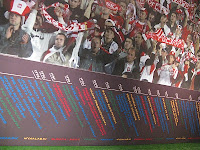 While we waited for the St. Mary's Church to open, we stopped by the Historical Museum of the City of Krakow, which sounded idly interesting in the guidebook. There was a special exhibition of the history of Poland from 1768 to 1815, a time during which Poland was divided among Russia, Germany and Austria. The exhibition made a very complex subject engaging by using the metaphor of a football game, starting with a locker room with cabinets displaying important tools and historical objects, then identifying the players, the teams, and the coaches and providing a historical score chart. Of course, the exhibition was especially effective since we saw it at the time of some of the important games of the World Cup. Everywhere we went, people gathered in plazas, cafes, and restaurants to watch the games and after each game the winners' constituents would parade through the streets cheering and singing patriotic songs. On our last day, in Prague, Germans wrapped in their flag were everywhere, only to disappear after Spain defeated Germany.
From Wrocław we continued on the highway across a region of flat farmland to Krakow, where we the Rezydent Hotel is on a one way street leading out from the main square in which traffic is strictly prohibited. There was no way to get to the hotel by car, so we finally parked in a small lot down a narrow alley and walked to it. We had fortuitously parked in the hotel’s designated lot. Parking in that lot cost 80 zlotys (about $27) a day, increasing the daily cost to $99. We brought our bags up from the car. Up two flights of stairs, out a door and across a balcony and in through another door, our room was small and plain but clean and modern, with an excellent new bathroom and a flat screen tv. The only soap was in those wall dispensers that are ecologically correct, but I prefer bar soap and shampoo. The only window opened onto the walkway, so there was no privacy when we opened the curtains. With only a fan, this made it a bit stuffy on warm nights. The front desk staff seemed sullen and not particularly helpful until our third day, when a very helpful woman appeared. Breakfast is two doors down the street, the usual meat cheese, hard boiled and scrambled eggs, sausage, bread, condiments, and juice. In the warm weather walking outside to get to the room and to breakfast was pleasant, but in winter or in rainstorms it might not be very appealing. The hotel has many rooms, some served by an elevator. We were unable to see other rooms, but were informed that we had been upgraded to a superior double. The hotel is very close to the main square and lots of good restaurants and cafes.
 Our first evening we found a lovely restaurant on the square with a fine view of St. Mary's church. A few minutes after we sat down, the hour struck and the bugler who plays his plaintive melody every hour opened his window and played. It's the upper window in the left tower; I took the photograph from my seat in the restaurant. We heard the bugle several more times during our stay
The art museum in Krakow is closed for renovation. Looking for a museum, we decided to check out the one devoted to the Krakow playwright, stage designer, poet and artist Stanislaw Wyspianski (1869-1907). The museum displayed several drawings and paintings of Wyspianski, as well as designs for stained glass windows and wall decorations for the renovation of St. Mary’s church in Krakow. Upon leaving the museum, we happened on St. Francis church, whose walls are covered with Wyspianski’s floral designs and angels and which has amazing stained-glass windows by Wyspianski. These all-encompassing designs reflect both the concept of the Gesamtkunstwerk and the decorative style of art nouveau and the Arts and Crafts movement. Both St. Mary’s and this church are amazing in their rich, darkly colored overall patterned decoration.


We visited Wawel Castle and toured one section of rooms.If you’ve never seen a castle before, it’s probably great. We had. The nearby cathedral houses the tombs of the kings of Poland, and some of them are major monuments, particularly Veit Stoss's red stone tomb of Casimir IV Jagiello.
 We also walked around the area of Kazimierz, the former Jewish ghetto, visited the High Synagogue, displaying photographs of pre-World War II Jewish life in Krakow, had a glass of wine on the square there and had dinner at a peculiar little Jewish restaurant, Once Upon a Time in Kazimierz (Szeroka 1), that occupies three shops whose walls have been removed but the spaces still display items that relate to the previous businesses – woodworking tools, sewing machines and clothing.. The name of the place is so obscure that the people in the restaurant next door did not know where it was.
 Our second day in Krakow we spent at Auschwitz-Birkenau, not something one can just write about here. Appropriately, it was the only day we had clouds and rain.

Afterwards, we went to a concert of Bach and Chopin in a palace, then had an extravagant dinner at Restaurant Wierzynek. We ate in one of their beautiful interior rooms, where a monumental painting depicts the historic 1364 banquet the owner served to celebrate the marriage between Holy Roman Emperor Charles IV and the granddaughter of Polish King Casimir the Great.
Everywhere in the country we saw evidence of the strong commitment to Catholicism in Poland, from the many mentions of, and monuments to, the Polish Pope John Paul II to the enormous attendance at church services and the numerous extravagantly decorated medieval, baroque, and nineteenth-century churches. One reason I decided to go to Krakow was to see the Veit Stosz altarpiece of the Life of the Virgin in St. Mary’s church there. We tried a couple of times to go in, but they were always in the middle of services, so finally on the day we were leaving we paid admission to see the altarpiece closed, and then opened. A nun comes out, takes a pole with a hook on the end, and drags each wing opn. The change from exterior to interior is striking, since the huge twice life-size inside figures of the death and Assumption of the Virgin are brightly gilt. It, and the elaborately decorated church (by Wyspianski, among others) were worth the wait.

 While we waited for the St. Mary's Church to open, we stopped by the Historical Museum of the City of Krakow, which sounded idly interesting in the guidebook. There was a special exhibition of the history of Poland from 1768 to 1815, a time during which Poland was divided among Russia, Germany and Austria. The exhibition made a very complex subject engaging by using the metaphor of a football game, starting with a locker room with cabinets displaying important tools and historical objects, then identifying the players, the teams, and the coaches and providing a historical score chart. Of course, the exhibition was especially effective since we saw it at the time of some of the important games of the World Cup. Everywhere we went, people gathered in plazas, cafes, and restaurants to watch the games and after each game the winners' constituents would parade through the streets cheering and singing patriotic songs. On our last day, in Prague, Germans wrapped in their flag were everywhere, only to disappear after Spain defeated Germany.
 Krakow is more than six hours driving from Prague. The guidebooks say to stick to the highways wherever possible because the smaller roads are full of slow traffic and congestion in the multiple towns and villages along the way. This is completely true and the scenery on the smaller roads is not interesting enough to make up for the frustrating delays. Nonetheless, we got to Prague in about 8 hours despite frequent driving rain.
Friday, 16 July 2010
Travel and Blogging
This is the first time I've written about a trip, rather than focus on reviewing the art and art exhibitions we traveled to see, and I've discovered some benefits, a sort of "Why we travel, and blog later." I'm taking a break in the sequence to mention three of the many things that have I've learned in the process, and to acknowledge the usefulness of the Internet for broadening my knowledge about anything. It's great when you can Google the name of a Polish artist you never heard of and find extensive information on his or her work, plus additional images. And it's frustrating when you get virtually nothing.
First, Augustus the Strong, the Elector of Saxony and King of Poland who was responsible for a huge portion of the amazing art collections in Dresden. I'm still learning about the political situation during his reign and about his art patronage, as well as trying to understand the complex map of northern Europe during his day (Italian Renaissance politics begins to seem simple and straightforward compared to that of the area that would become Germany.) I learned that he was called Augustus the Strong because of his great strength, illustrated by the fact that he could win at fox tossing using just his pinkie finger. Fox tossing?
We went to the ossuary in Sedlec, near Kutna Hora in Czech Republic. In graduate school my colleagues would talk about the macabre chapel in Rome on the Via Veneto, and I just now recall that there was also one in Milan. I'd never taken the time from my research focus to visit them, so Sedlec was a first. Now I'm hoping to get to some of the others. The Web provides extensive information, history, and pictures of several bone chapels.

 Third, in the National Museum in Wroclaw I was attracted to a very large 19th century painting by an artist I'd never heard of, Wilhelm Leopolski (1826, 28 or 30-1892). I'll put in my snapshots here, but there are multiple images on the Web and you can buy reproductions in various sizes and styles. I was attracted by the huge size of the painting, its historical-style subject, and the very fresh paint handling, possibly visible in my detail of his hand and drapery. The title is The Death of Acernus, 1867. Thinking this must be some classical subject that I'd never heard of, I started Googling Acernus, only to find that it is the Latin pseudonym for a Polish writer and poet of the second half of the sixteenth century, Sebastian Fabian Klonowic, who was called "the Sarmation Ovid." He died in the public hospital in Lublin, Poland. Most of his works were burned by the nobles and the Jesuits and the rest are scarce. There seems to have been a significant interest in him in the mid-19th century. Not reading Polish, I haven't found more information beyond lists of the titles of his works. There are two other versions of this painting, one in the Lviv Art Gallery (Lvov), Ukraine. I've found almost nothing about Leopolski except the many reproductions of his paintings.
First, Augustus the Strong, the Elector of Saxony and King of Poland who was responsible for a huge portion of the amazing art collections in Dresden. I'm still learning about the political situation during his reign and about his art patronage, as well as trying to understand the complex map of northern Europe during his day (Italian Renaissance politics begins to seem simple and straightforward compared to that of the area that would become Germany.) I learned that he was called Augustus the Strong because of his great strength, illustrated by the fact that he could win at fox tossing using just his pinkie finger. Fox tossing?
We went to the ossuary in Sedlec, near Kutna Hora in Czech Republic. In graduate school my colleagues would talk about the macabre chapel in Rome on the Via Veneto, and I just now recall that there was also one in Milan. I'd never taken the time from my research focus to visit them, so Sedlec was a first. Now I'm hoping to get to some of the others. The Web provides extensive information, history, and pictures of several bone chapels.

 Third, in the National Museum in Wroclaw I was attracted to a very large 19th century painting by an artist I'd never heard of, Wilhelm Leopolski (1826, 28 or 30-1892). I'll put in my snapshots here, but there are multiple images on the Web and you can buy reproductions in various sizes and styles. I was attracted by the huge size of the painting, its historical-style subject, and the very fresh paint handling, possibly visible in my detail of his hand and drapery. The title is The Death of Acernus, 1867. Thinking this must be some classical subject that I'd never heard of, I started Googling Acernus, only to find that it is the Latin pseudonym for a Polish writer and poet of the second half of the sixteenth century, Sebastian Fabian Klonowic, who was called "the Sarmation Ovid." He died in the public hospital in Lublin, Poland. Most of his works were burned by the nobles and the Jesuits and the rest are scarce. There seems to have been a significant interest in him in the mid-19th century. Not reading Polish, I haven't found more information beyond lists of the titles of his works. There are two other versions of this painting, one in the Lviv Art Gallery (Lvov), Ukraine. I've found almost nothing about Leopolski except the many reproductions of his paintings.
Subscribe to:
Posts (Atom)

